Executive Summary
The myth says a serious business always ends up on Salesforce. The reality is that GoHighLevel vs Salesforce is a question about scale, not prestige. Salesforce is the enterprise CRM standard, with deep customization, a massive ecosystem, and sales cloud features priced per user per month on annual contracts. GoHighLevel bundles CRM, funnels, websites, email, SMS, phone, and white-label sub-accounts into one flat monthly price with unlimited contacts. One platform is built for large sales organizations; the other is built for agencies and SMBs that need speed.
- Best For: agencies and growing SMBs that need CRM, funnels, email, SMS, and client delivery in one managed system (GoHighLevel); mid-market and enterprise teams that need a customizable, deeply integrated CRM backbone (Salesforce).
- Pricing: GoHighLevel $97/$297/$497 per month flat with unlimited contacts; Salesforce Starter Suite $25/user/month and Pro Suite $100/user/month, billed annually with contract requirements.
- Strength (GHL): all-in-one CRM, funnels, email, SMS, phone, and agency sub-accounts with flat pricing.
- Strength (Salesforce): enterprise-grade customization, AppExchange ecosystem, and advanced sales features.
Below we compare both platforms across pricing, CRM, sales features, automation, funnels and marketing, integrations, agency use cases, and learning curve, then give a clear verdict for different buyer profiles. For a deeper side-by-side breakdown, see this GoHighLevel vs Pipedrive comparison.
Table of Contents
- Agency Speed vs Enterprise Depth: The Quick Call
- Two Buyer Philosophies: Seat-Based Depth vs Flat-Rate Speed
- One Is a Sales Cloud, the Other Is a Business Engine
- GoHighLevel vs Salesforce Pricing Compared
- CRM and Pipelines
- Sales Features and Quoting
- Automation and Workflows
- Build the Agency Follow-Up Engine in GoHighLevel
- Two Illustrative Scenarios: A Ten-Rep Team and a Twelve-Client Agency
- Marketing, Funnels, and Email
- Integrations and Ecosystem
- Agency and Multi-Client Use
- Who Actually Runs the Tool Day to Day
- Count Your Users, Then Map Your Sales Process
- Where GoHighLevel Pulls Ahead for Agencies
- FAQ
- The Platform That Fits Your Org Chart
Agency Speed vs Enterprise Depth: The Quick Call
For agencies, SMBs, and operators who want a complete business engine, GoHighLevel is the stronger value: you get CRM, funnels, email, SMS, phone, and automation in one flat price with unlimited contacts, and you can white-label it for clients. Salesforce is the stronger choice for mid-market and enterprise teams that need deep customization, a proven enterprise CRM, and an enormous integration ecosystem, and that can absorb per-user licensing and implementation costs. In 2026, the deciding factor is organizational scale: GoHighLevel wins for speed and value; Salesforce wins for enterprise depth.
Two Buyer Philosophies: Seat-Based Depth vs Flat-Rate Speed
A buyer picks Salesforce because the sales process is the product. Large teams need forecasting, quoting, approval chains, territory management, and reporting that can be sliced by rep, region, and quarter. The budget logic follows the org chart: per-user licensing on an annual contract is normal when hundreds of reps depend on the system. Ownership sits with an admin or consultant who configures objects, permissions, and flows. The tool is expected to bend to the business, even if that takes months.
A buyer picks GoHighLevel because client delivery is the product. An agency needs a landing page live this week, an SMS follow-up running tomorrow, and a separate workspace for each client. Flat pricing with unlimited contacts means adding a client does not add a license negotiation. The owner is the operator, not an admin. Speed matters more than modeling every edge case. For a closer look at how the flat-rate model works in practice, see this GoHighLevel pricing breakdown.
Each philosophy breaks down at the edges. Salesforce gets expensive and slow when a five-person shop only needs proposals, funnels, and follow-up; the admin burden arrives before the revenue does. GoHighLevel runs out of road when a sales organization needs enterprise forecasting, complex CPQ, or thousands of AppExchange integrations. Neither failure is a flaw in the software. It is a mismatch between the tool and the org chart.
The real decision point is not the feature list. It is who will own the tool after launch. If the answer is a dedicated admin serving a large sales team, Salesforce fits. If the answer is the agency owner serving many client accounts, GoHighLevel fits. Teams that force the wrong philosophy usually pay twice: once for the license and once for the workaround.
One Is a Sales Cloud, the Other Is a Business Engine
Salesforce is the world’s leading enterprise CRM. The Sales Cloud covers leads, accounts, opportunities, forecasting, quoting, and team collaboration, with an app marketplace (AppExchange) of thousands of integrations and a huge developer ecosystem. It is powerful, customizable, and typically deployed with admins and consultants.
GoHighLevel is an all-in-one platform for agencies and SMBs. It includes a full CRM with pipelines and custom fields, funnels and websites, email marketing, SMS, call tracking, phone, voice AI, surveys, reputation management, and agency sub-accounts. It is designed to be clicked into production quickly and to run client operations end to end.
GoHighLevel vs Salesforce Pricing Compared
| Plan | Monthly Price | Key Limits | Best For |
|---|---|---|---|
| GoHighLevel Starter | $97/month | 3 sub-accounts, core CRM, funnels, email, SMS, unlimited contacts | SMBs |
| GoHighLevel Unlimited | $297/month | Unlimited sub-accounts, full funnels + websites + phone | Agencies |
| GoHighLevel Agency Pro | $497/month | SaaS mode, whitelabel, advanced features | Reselling agencies |
| Salesforce Starter Suite | $25/user/month | Turnkey CRM, email nurture, lead routing (transaction fees apply) | Small teams |
| Salesforce Pro Suite | $100/user/month | Everything in Starter plus quoting, forecasting, automation (annual contract) | Growing businesses |
| Salesforce Enterprise | Custom / higher | Advanced customization, workflows, API, enterprise support | Mid-market / enterprise |
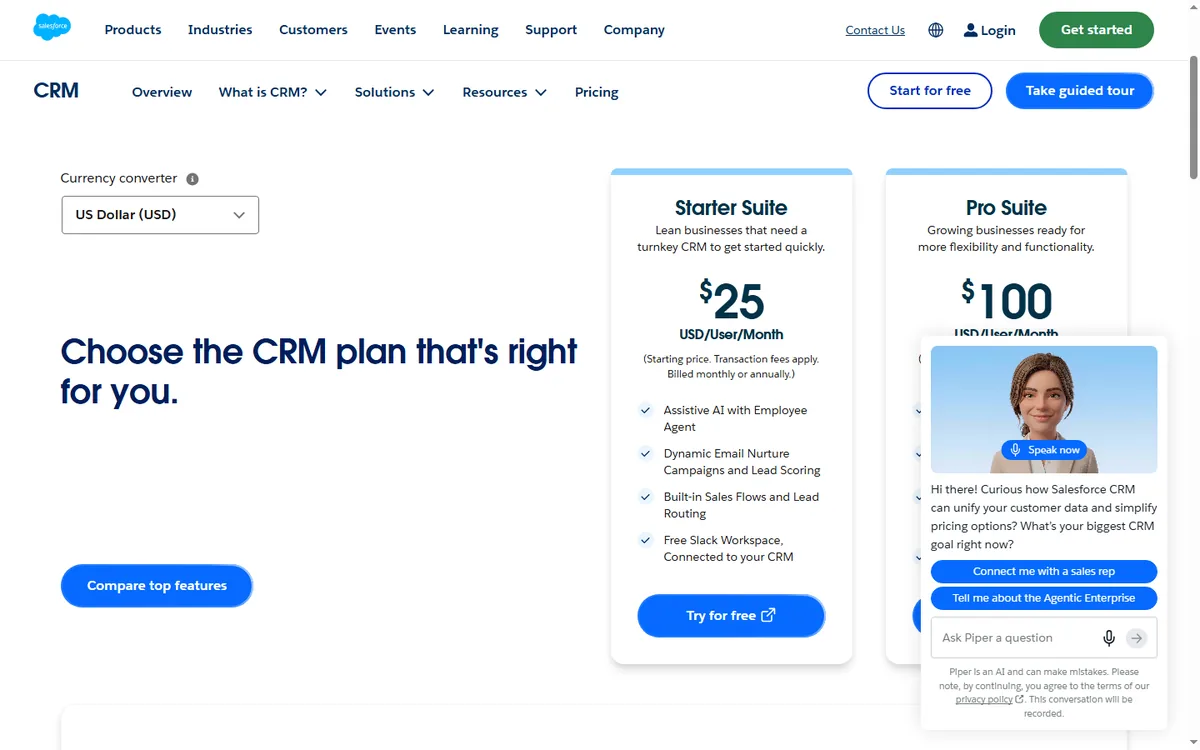
Salesforce pricing is per user per month and typically requires an annual contract for the more useful tiers. A 10-user Pro Suite team pays $1,000/month before add-ons, implementation, and admin time. GoHighLevel charges a flat monthly rate with unlimited contacts and per-seat licensing is not the model. For an agency or SMB with 5-20 users, GoHighLevel is dramatically cheaper. For an enterprise with hundreds of sales reps, per-user pricing is normal and Salesforce’s scale pays off.
CRM and Pipelines
Salesforce is the gold standard for CRM. Leads, accounts, contacts, opportunities, custom objects, validation rules, and reporting are enterprise-grade. You can model almost any sales process, and the reporting engine is the deepest in the industry. The trade-off is complexity: configuration often requires an admin or consultant.
GoHighLevel is CRM-first but simplified. Pipelines, custom fields, opportunities, tasks, and per-contact activity history across email, SMS, calls, forms, and payments are native. For agency client work, each client gets its own sub-account with an isolated CRM workspace. It covers the 90% of CRM needs that most SMBs and agencies have, without the enterprise configuration burden.
Sales Features and Quoting
Salesforce Pro Suite adds quoting, sales forecasting, and enhanced automation, plus AppExchange for CPQ and other sales tools. For complex B2B sales with approval chains, revenue recognition, and territory management, Salesforce is unmatched.
GoHighLevel includes pipelines, quotes, proposals, and payments natively, which is enough for service businesses and agencies that send proposals and collect deposits. It does not offer enterprise forecasting or territory management. If your sales process needs heavy quoting and CPQ, Salesforce is the answer; if you need proposals and payments inside your CRM, GoHighLevel handles it.
Automation and Workflows
Salesforce automation is powerful but rule-based: flows, process builder, and workflow rules. Building sophisticated automation requires training or an admin, and while it is enterprise-grade, it is not typically a weekend project.
GoHighLevel workflows trigger on contact behavior across email, SMS, calls, forms, page visits, and payments, then run email, SMS, internal actions, and even AI voice. One workflow can send an email, log a call, and update a pipeline at the same time. For operators, GoHighLevel automation is more accessible and multi-channel out of the box.
Build the Agency Follow-Up Engine in GoHighLevel
This is the exact automation an agency can build for a client sub-account: capture a lead, book a call, remind, follow up, and request a review. Every step uses a native GoHighLevel building block.
- Trigger: Form Submitted (the client’s “Free Strategy Call” form). Action: Create/Update Opportunity in the pipeline stage “New Lead.” Action: Send SMS ‘Hi {{contact.first_name}}, your strategy call request is in. Grab a slot here: {{appointment_link}}.’
- Wait: until the contact books an appointment, up to 48 hours. If/Else: if an appointment exists, go to step 3. If not, Action: Send Email with subject ‘Still want that strategy call?’ and a single booking link, then Add Task for the account manager to call.
- Trigger: Customer Booked Appointment. Action: Send SMS ‘You are booked for {{appointment.start_time}}. Reply C to confirm or R to reschedule.’ Action: Internal Notification to the assigned user.
- Wait: until 24 hours before the appointment. If/Else: if the contact replied C, Action: Send SMS ‘See you tomorrow. Here is what to prepare: {{custom_values.prep_link}}.’ If the contact replied R, Action: Send SMS with the reschedule link and Remove from Workflow.
- Wait: until 2 hours before the appointment. Action: Send SMS ‘Reminder: your call is in 2 hours. Reply H if you need help.’
- Trigger: Appointment Status changes to Showed. Action: Update Contact Field “stage” to “Consult Done.” Action: Send Email with the proposal and payment link. Wait: 3 days.
- If/Else: if Payment Received fires within 3 days, Action: Add Contact Tag “client” and Create/Update Opportunity to “Won.” If not, Action: Send SMS ‘Any questions on the proposal? Reply here and I will answer today.’
- Trigger: Payment Received. Wait: 7 days. Action: Send Review Request to the client’s Google profile. Action: Add Contact Tag “review requested.”
Measure four numbers weekly: form-to-booking rate, confirmation reply rate, show rate, and proposal-to-payment rate. Say a client books 40 calls a month and 10 of them go quiet; if the two-hour nudge brings back 4 of those 10, and a booked call is worth $150 to that client, the nudge is worth $600 a month on its own. Track each number per client sub-account so the agency can show the value of the retainer. For a deeper look at how GoHighLevel stacks up against another all-in-one option, read this GoHighLevel vs HubSpot comparison.
Running the same flow on Salesforce means building it with flows, process builder, and workflow rules, which usually needs admin training or a consultant, and the funnel, SMS, and review pieces sit outside Sales Cloud as separate products.
Two Illustrative Scenarios: A Ten-Rep Team and a Twelve-Client Agency
These are illustrative scenarios, not reports of real deployments.
Imagine a B2B equipment distributor in Columbus, Ohio, with 10 sales reps and a sales manager. The team runs on Salesforce Pro Suite at $100 per user per month, so licensing alone reaches $1,000 each month, and that figure excludes add-ons, setup work, and the time of whoever administers the account. The manager wants quoting, forecasting, and a funnel for a new inbound campaign.
Sales Cloud by itself has no funnel builder or email marketing, so the campaign needs another product with another cost and setup. The team keeps Salesforce as the system of record because the forecasting and quoting depth is the reason it was bought. The lesson is that per-user pricing is normal at this scale, but every extra marketing need becomes a separate line item.
Imagine a marketing agency in Austin, Texas, with 6 staff and 12 retainer clients. Each client needs its own CRM workspace, landing pages, email sequences, and SMS reminders. Running each client on a separate per-user CRM means 12 implementations, 12 sets of licenses, and an admin to maintain them. On GoHighLevel Unlimited at $297 a month, each client gets an isolated sub-account with its own pipelines, forms, pages, and workflows. If the agency bills each client $500 a month for CRM and follow-up management, 12 clients bring $6,000 a month against a flat platform cost, before any ad spend. The arithmetic is simple: flat pricing rewards adding client accounts, while per-user pricing punishes it.
Marketing, Funnels, and Email
Salesforce has Marketing Cloud and Pardot for enterprise marketing, but these are separate products with separate costs and setup. Sales Cloud alone does not include a funnel builder, landing pages, or email marketing.
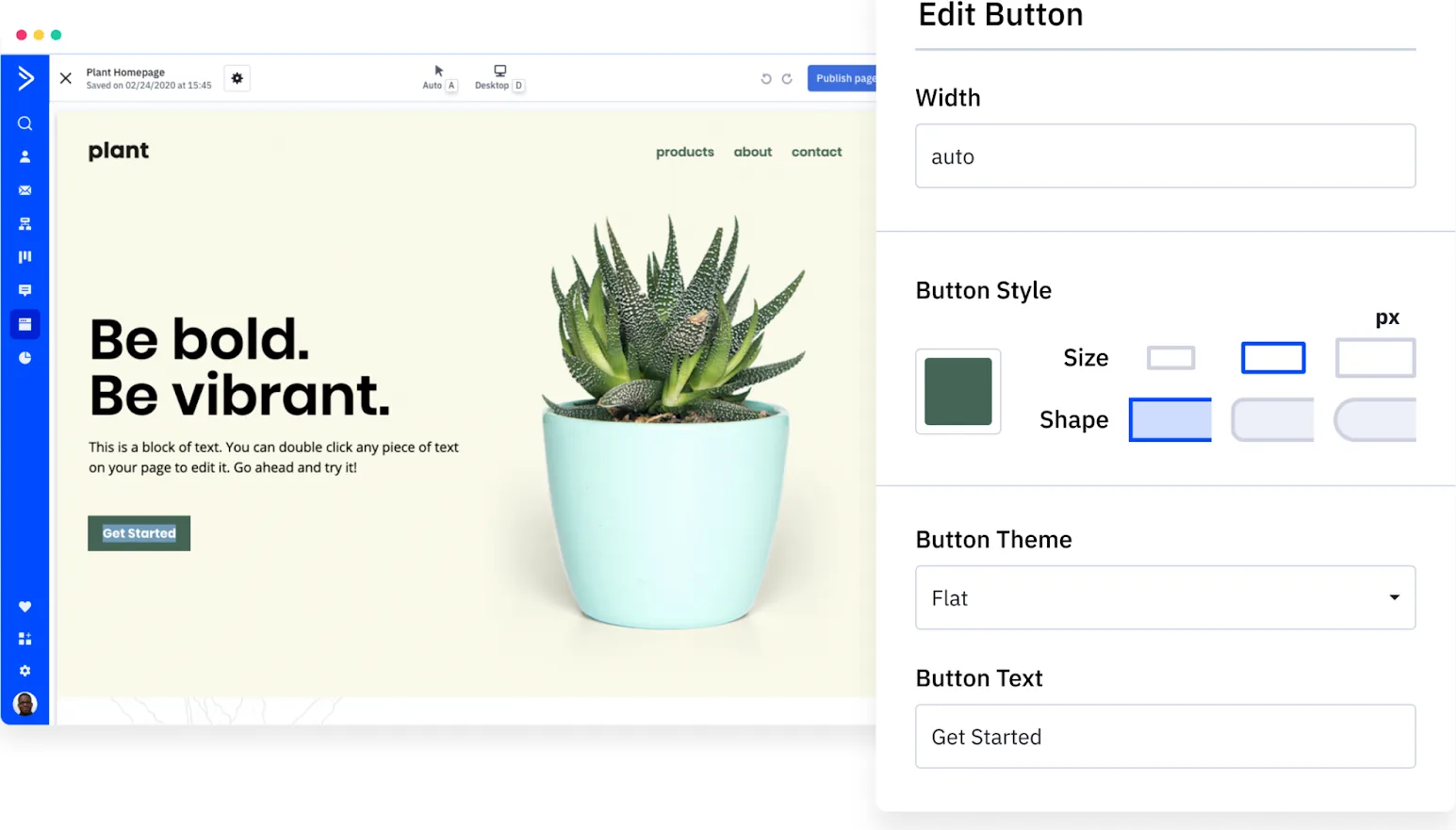
GoHighLevel bundles funnels, websites, email marketing, SMS, surveys, and reputation management into the core subscription. You can launch a landing page, send an email sequence, and track the lead in the pipeline without leaving the platform. For SMBs and agencies, GoHighLevel’s built-in marketing is a major advantage over Salesforce Sales Cloud alone.
Integrations and Ecosystem
Salesforce AppExchange is the largest CRM ecosystem in the world, with thousands of apps, from CPQ to marketing to analytics. Any serious enterprise tool integrates with Salesforce. If your stack depends on a specific enterprise integration, Salesforce is likely covered.
GoHighLevel has a native marketplace, API, and webhooks, and connects with Zapier and Make for thousands of apps. It covers the integrations most agencies and SMBs need without the enterprise integration surface. For custom enterprise systems, Salesforce has the edge; for practical SMB stacks, GoHighLevel is enough.
Agency and Multi-Client Use
GoHighLevel is built for agencies. Sub-accounts give each client an isolated workspace with its own CRM, funnels, sites, and automations. On Agency Pro you get SaaS mode and white-label capabilities to resell the platform as your own product. Managing dozens of client accounts inside one system is the core design.
Partner programs exist, but each client deployment is a separate implementation project with licensing, admins, and consultants. For an agency that wants to white-label CRM for clients, GoHighLevel is the natural fit.
Who Actually Runs the Tool Day to Day
Salesforce has a steep learning curve and typically requires admin training or a consultant. The platform is powerful but dense, and best practices matter. Trailhead offers free training, but real deployments take time.
GoHighLevel is designed for operators. You click through CRM, funnels, websites, and workflows rather than configuring objects and permissions. HighLevel provides free training, an academy, and a large agency community. Most operators find the platform clickable within a few days, and maintenance is handled by the vendor.
Count Your Users, Then Map Your Sales Process
- Pick GoHighLevel when your agency, SMB, or service business wants a single flat-priced system covering contacts, pipelines, landing pages, messaging, and client delivery.
- Choose Salesforce if you are a mid-market or enterprise team that needs deep CRM customization, advanced sales features, and a proven enterprise ecosystem.
- Choose by users: Salesforce prices per user with annual contracts; GoHighLevel is a flat rate with unlimited contacts and seats.
- Choose by ownership: if you want to white-label and resell the platform, GoHighLevel’s SaaS mode is unique; Salesforce is not a reseller platform.
A practical way to decide: count your users and map your sales process. If you have a handful of users and need proposals, funnels, and follow-up without an admin, GoHighLevel is the faster, cheaper answer. If you have a large sales organization with complex processes and enterprise integration requirements, Salesforce earns its cost.
Where GoHighLevel Pulls Ahead for Agencies
- GoHighLevel: flat pricing with unlimited contacts and seats.
- GoHighLevel combines contact management, landing pages, messaging channels, calling, and workflow automation under one subscription.
- GoHighLevel: agency sub-accounts, white label, and SaaS mode.
- GoHighLevel: fast to deploy without an admin or consultant.
- Salesforce: enterprise-grade CRM with deep customization.
- Salesforce: vast AppExchange ecosystem and integrations.
- Salesforce: advanced sales features, quoting, and forecasting.
Where Salesforce Still Wins on Depth
- GoHighLevel: less customization and reporting depth for complex enterprise processes.
- GoHighLevel: not built for thousands-of-reps sales organizations.
- Salesforce: per-user pricing and annual contracts get expensive fast.
- Salesforce: steep learning curve and admin/consultant costs.
- Salesforce: no funnel builder or email marketing in Sales Cloud alone.
FAQ
Is GoHighLevel better than Salesforce? For agencies, SMBs, and operators who need an all-in-one platform with flat pricing, GoHighLevel is usually better. Salesforce suits larger organizations needing heavy customization and a long-established enterprise CRM.
Can GoHighLevel replace Salesforce? For most SMB and agency CRM needs, yes. GoHighLevel includes pipelines, contacts, email, SMS, funnels, and automation. If you need enterprise-grade customization, complex CPQ, or thousands of integrations, Salesforce remains the choice.
Which is cheaper, GoHighLevel or Salesforce? GoHighLevel starts at $97/month flat with unlimited contacts and seats. Salesforce charges $25/user/month for Starter Suite and $100/user/month for Pro Suite on annual contracts, so a 10-user team pays $1,000/month before add-ons.
Does GoHighLevel have quoting like Salesforce? GoHighLevel includes proposals, quotes, and payments natively, which suits service businesses and agencies. Salesforce Pro Suite adds enterprise quoting, forecasting, and advanced automation.
Which is better for an agency? GoHighLevel, because of sub-accounts, white label, SaaS mode, and the unified CRM.
Can I use GoHighLevel and Salesforce together? Yes, some teams use Salesforce as the system of record and GoHighLevel for funnels and marketing, but that duplicates cost and data. Most operators pick one core platform.
The Platform That Fits Your Org Chart
Staying on the wrong platform has a quiet cost: per-user licenses for staff who never log in, an admin retainer for changes you could click through yourself, and marketing tools billed separately from the CRM. Every month of waiting keeps that total on the books. The first step is small: count your users, list the client accounts you manage, and map one follow-up flow end to end. If the math points to flat pricing and agency speed, start a GoHighLevel trial and build that flow before you commit. For a side-by-side with another agency-friendly CRM, see this Hubflo review for agencies.
Disclaimer: We are an independent review site. Some links in this article are affiliate links, and we may earn a commission at no extra cost to you if you purchase through them. We only recommend tools we test in real client operations.
About the Author

Antonio Vance is B2B SaaS Operations Director & Lead Reviewer (SaaSFlowLab Editorial Team). He has spent 8+ years deploying and auditing enterprise CRM, marketing automation, and email deliverability infrastructures for digital agencies. At SaaSFlowLab, he directs hands-on testing of software stacks in live production environments to deliver uncompromised, field-verified software reviews.