
Executive Summary
The common advice that a funnel builder is all you need to launch an offer is only half true. A page can capture a lead, but the follow-up, the pipeline, and the phone call that closes the deal live somewhere else. That is the real GoHighLevel vs ClickFunnels split: ClickFunnels is a focused funnel and sales-page builder for shipping offers fast, while GoHighLevel wraps funnels inside a CRM, email, SMS, phone, and agency sub-accounts. The deciding factor is scope, not page design.
- Best For: agencies and SMBs that need funnels plus CRM, email, and automation in one place (GoHighLevel); solo founders who want a streamlined funnel-first tool (ClickFunnels).
- Pricing: GoHighLevel $97/$297/$497 per month; ClickFunnels Launch $97, Scale $197, Optimize $297 per month (with annual discounts).
- Strength (GHL): complete CRM + marketing automation + sub-accounts around funnels.
- Strength (CF): mature funnel templates, email follow-up, and a simpler learning curve for pages.
Below we compare both builders across pricing, funnel features, CRM depth, email, automation, agency use cases, integrations, and learning curve, then give a clear verdict for different buyer profiles.
Table of Contents
- Funnel Builder or Full Operating System?
- Two Buyer Philosophies: Funnel-First vs Stack-First
- ClickFunnels Pages vs GoHighLevel’s Stack
- Pricing Compared
- Funnel Building Compared
- CRM and Contact Management
- Email Marketing and Automation
- Build the Funnel Follow-Up Flow in GoHighLevel
- Two Scenarios That Show the Split in Practice
- Agency and Multi-Client Use
- Why ClickFunnels Feels Faster to Learn
- Match the Tool to Your Campaign Stack
- Where Each Platform Earns Its Keep
- FAQ
- The Scope Test That Settles It
Funnel Builder or Full Operating System?
For agencies and businesses that want more than funnels, GoHighLevel is the stronger platform because it adds CRM, email sequences, automations, phone, and white-label sub-accounts around the same funnel builder. For a solo entrepreneur who primarily needs to build high-converting sales pages and follow-up emails without managing a full CRM, ClickFunnels remains a clean, specialized choice. In 2026, the deciding factor is scope: if funnels are one part of your operation, GoHighLevel wins; if funnels are your entire operation, ClickFunnels is easier to master.
Two Buyer Philosophies: Funnel-First vs Stack-First
A buyer picks ClickFunnels because the funnel is the business. Solo founders launching a course or a single offer want polished templates, order bumps, upsells, and email follow-up in one focused interface. They already have a CRM or do not need one yet. The budget logic is simple: pay for the page builder, keep the rest lean, and learn the tool in an afternoon.
A buyer picks GoHighLevel because funnels are one room in a larger house. Agencies and SMBs juggling multiple clients need pipelines, SMS, call tracking, and sub-accounts that stay isolated per client. The budget logic shifts from tool price to stack cost: one subscription replaces a funnel tool, a CRM, an email platform, and a phone system. The owner of the tool is usually an operator, not a page designer.
Each philosophy breaks down at its edge. Funnel-first thinking stalls when the same lead needs a text reminder, a pipeline stage, and a call log. You end up stitching integrations and paying for each one. Stack-first thinking stalls when a solo founder only needs a sales page and gets buried in modules, trial sending caps, and settings that do not move the offer forward.
The honest test is not which platform has more features. It is how many tools you touch to run one campaign. If the answer is one, ClickFunnels fits. If the answer is four, GoHighLevel consolidates them, and the GoHighLevel pricing plans start to look less like a cost and more like a replacement budget. Agencies weighing a broader switch can also read the GoHighLevel vs HubSpot breakdown.
ClickFunnels Pages vs GoHighLevel’s Stack
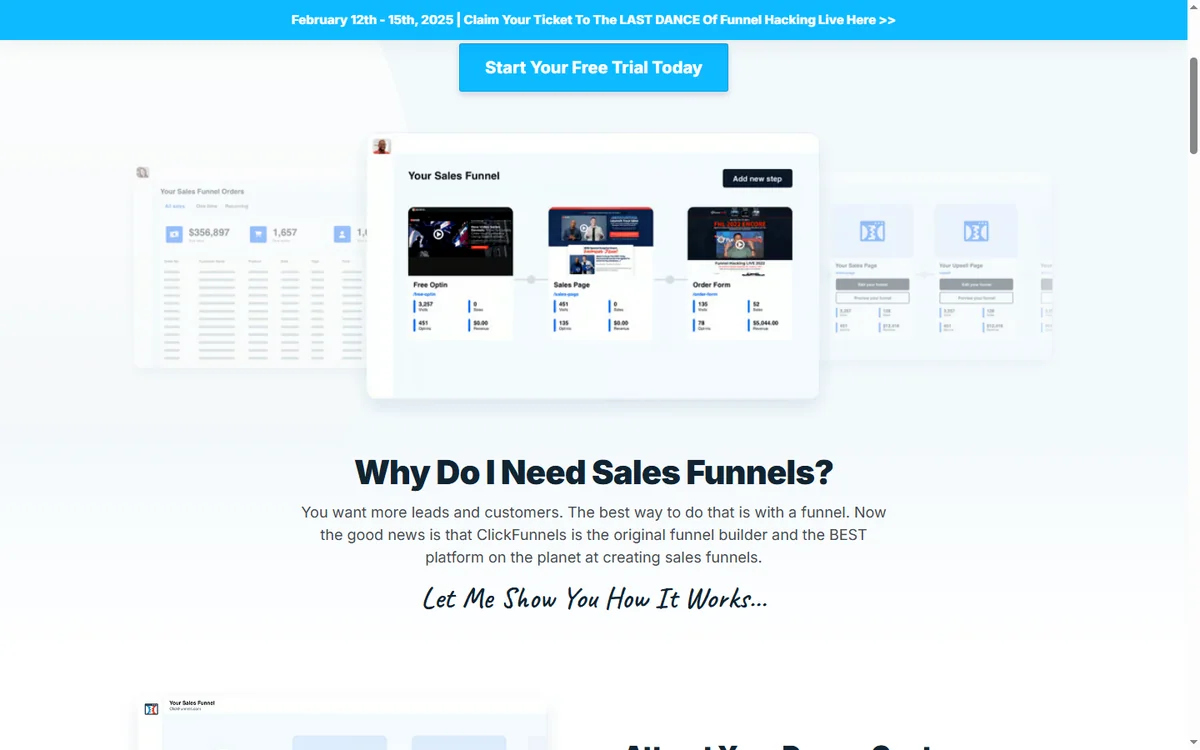
ClickFunnels is a funnel builder: you create landing pages, sales pages, order forms, and email follow-up sequences, then track conversions. It has added CRM-style capabilities over the years, but the core workflow is still funnel-first.
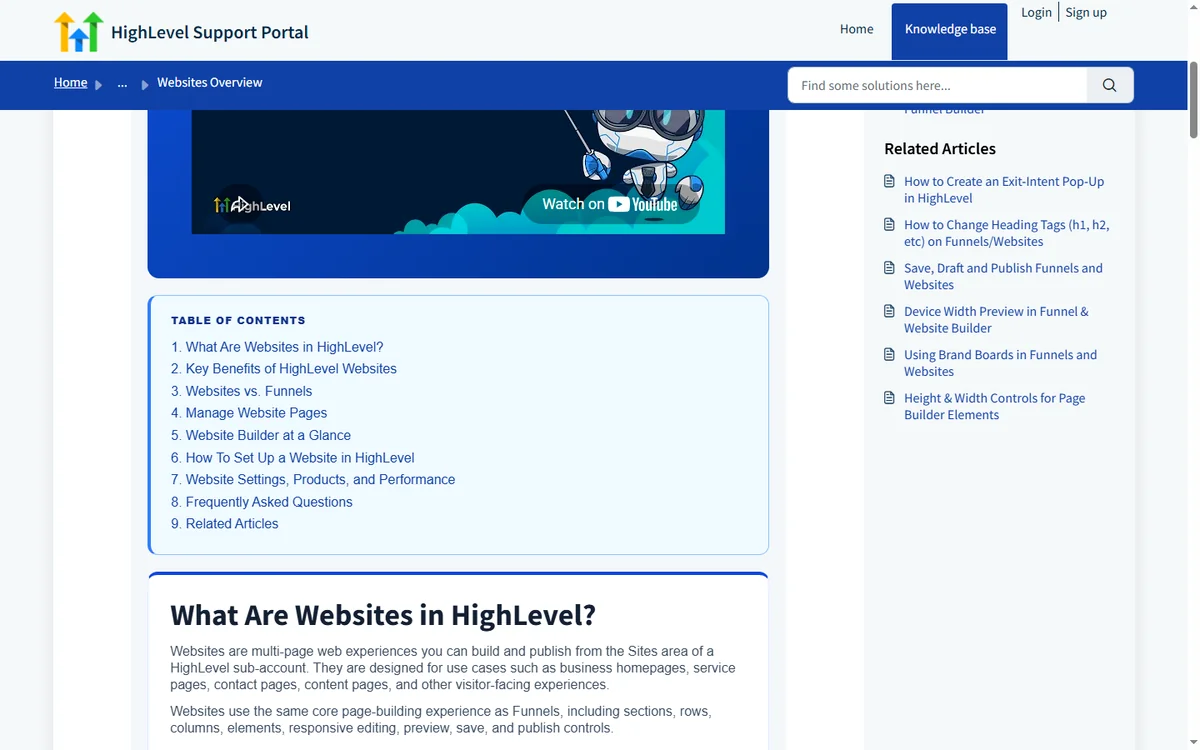
GoHighLevel is an all-in-one business operating system: funnels and websites are one module among many. You also get a full CRM with pipelines, email marketing, SMS, call tracking, voice AI, reputation management, surveys, and agency sub-accounts. That breadth is the main difference from ClickFunnels.
Pricing Compared
| Plan | Monthly Price | Key Limits | Best For |
|---|---|---|---|
| GoHighLevel Starter | $97/month | 3 sub-accounts, core CRM, funnels, email | SMBs |
| GoHighLevel Unlimited | $297/month | Unlimited sub-accounts, full funnels + websites | Agencies |
| GoHighLevel Agency Pro | $497/month | SaaS mode, whitelabel, advanced features | Reselling agencies |
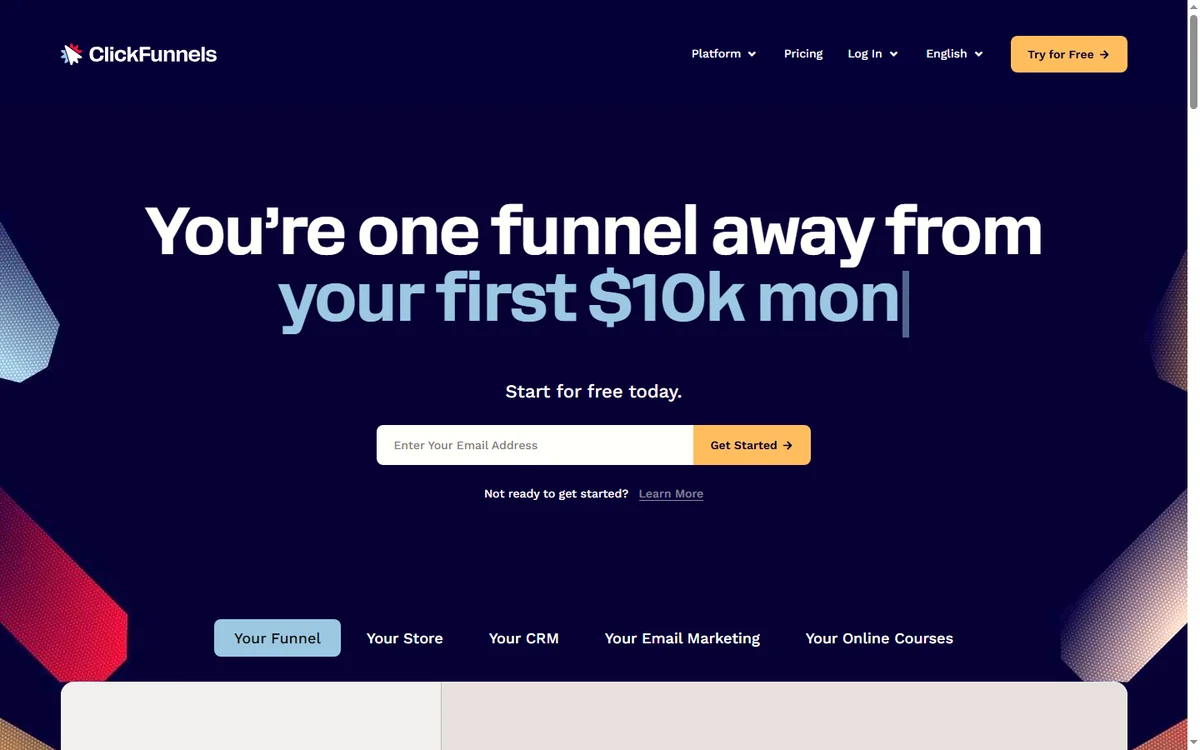
| ClickFunnels Launch | $97/month | Up to 1,000 contacts, funnels, email follow-up | Solo founders |
| ClickFunnels Scale | $197/month | Up to 10,000 contacts, advanced automations | Growing businesses |
| ClickFunnels Optimize | $297/month | Up to 50,000 contacts, priority support | Scale-ups |
At the entry level both cost $97 per month. The real difference is what you get for the money. ClickFunnels counts contacts and focuses on funnels and email. GoHighLevel includes unlimited contacts on each plan and bundles CRM, phone, and automation, which changes the cost equation for agencies.
Funnel Building Compared
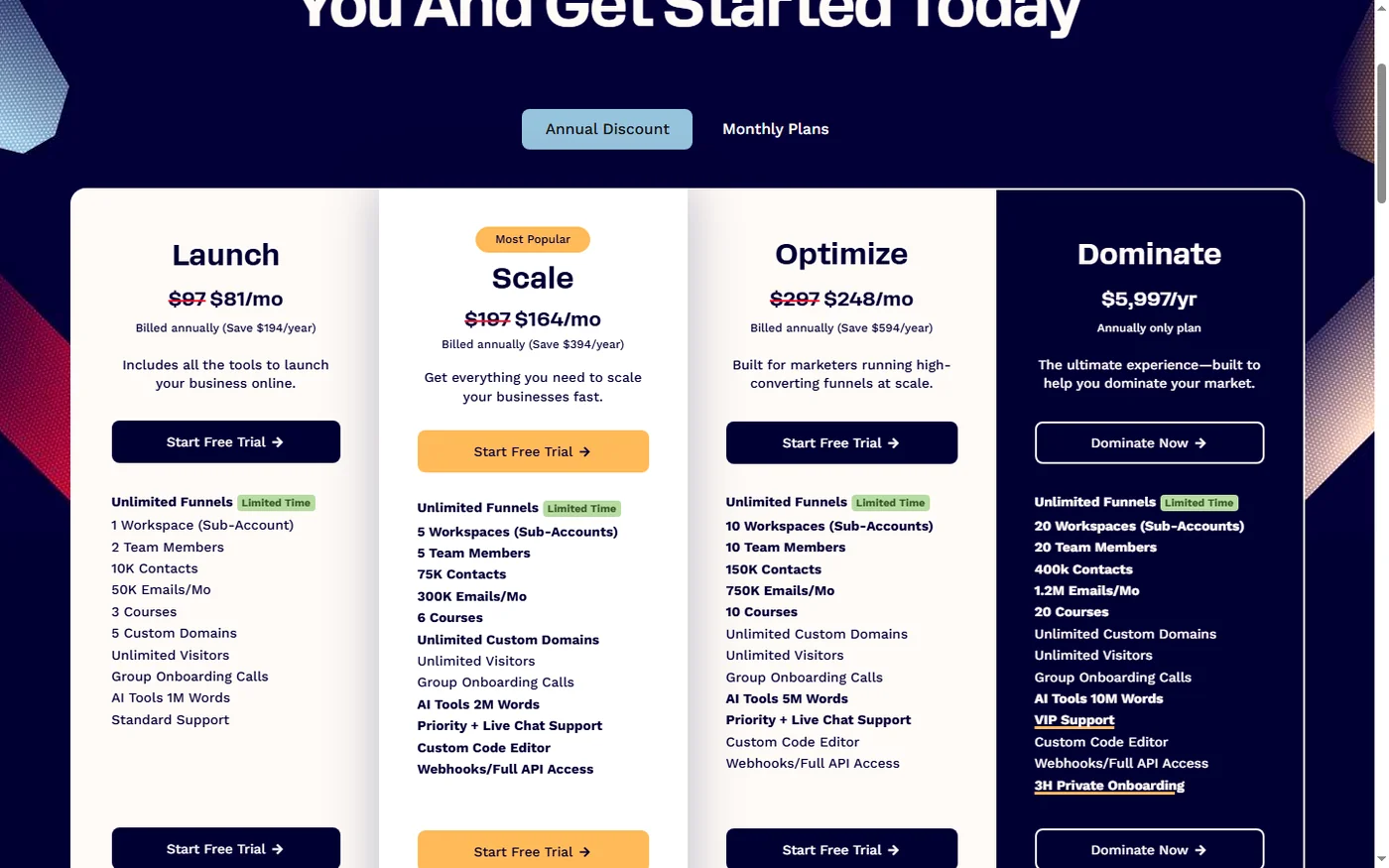
Both platforms let you build landing pages, sales pages, order forms, and thank-you pages with drag-and-drop editors. ClickFunnels has a strong library of funnel templates designed around common offers, plus a mature page editor with elements for every stage of a funnel.
- ClickFunnels strength: deep funnel template library, order bumps, upsells, downsells, and follow-up funnels.
- GoHighLevel strength: the same funnel builder sits next to websites, and every funnel connects natively to your CRM and automation.
If you live and breathe funnel optimization and want battle-tested templates, ClickFunnels has an edge. If you want funnels that feed straight into pipelines, email sequences, and phone tracking, GoHighLevel removes the integration work.
CRM and Contact Management
This is where the two platforms diverge most. ClickFunnels gives you contact records, tagging, and basic deal tracking, but it is not a full CRM. GoHighLevel is a complete CRM with pipelines, custom fields, tasks, opportunities, and per-contact activity history across email, SMS, calls, and forms.
For an agency running client work, CRM depth matters: you track every lead from first click to closed deal, then automate the next step. GoHighLevel’s pipelines and sub-accounts make that natural. ClickFunnels can handle entry-level CRM needs, but complex sales operations quickly outgrow it.
Email Marketing and Automation
Both platforms offer email campaigns and follow-up sequences. ClickFunnels bundles email follow-up with its funnel builder, which works well for course launches and offer funnels. GoHighLevel adds broader email marketing with broadcasts, sequences, and workflow-based automations tied to contact behavior across every channel.
- Broadcasts: both support one-to-many campaigns.
- Sequences: both support multi-step follow-up.
- Automation engine: GoHighLevel workflows trigger on form fills, page visits, payments, calls, and more.
- Channel unification: GoHighLevel combines email, SMS, and calls in one conversation timeline.
Sequence and Workflow Strength
ClickFunnels follow-up funnels are excellent for email-based product launches: you can chain emails, order bumps, and upsells inside one funnel. GoHighLevel workflows are broader; they trigger on contact behavior across forms, pages, payments, calls, and SMS, then run email, SMS, and internal actions together. If your follow-up is purely email, ClickFunnels is enough. If it crosses channels, GoHighLevel wins.
For a product launch, ClickFunnels is enough. For a business where the same contact moves through email, SMS, and phone, GoHighLevel’s unified automation is significantly more powerful.
Build the Funnel Follow-Up Flow in GoHighLevel
This is the automation that turns a funnel visit into a booked call, built entirely inside GoHighLevel workflows.
- Trigger: Form Submitted (the funnel’s strategy-call form). Action: Create/Update Opportunity in the pipeline stage ‘New Lead’. Action: Send SMS ‘Hi {{contact.first_name}}, thanks for requesting a call. What day works best this week? Reply with a day and we will lock a time.’
- Wait: 10 minutes. If/Else: contact replied. If yes, Action: Assign to User (round robin) and Action: Internal Notification ‘New lead replied — call within the hour.’ If no, Go To the email branch.
- Action: Send Email with subject ‘Your call request is in’ and a one-line body plus a booking link. Wait: 1 day.
- If/Else: opportunity stage is still ‘New Lead’. If yes, Action: Send SMS ‘Quick nudge, {{contact.first_name}} — do you want morning or afternoon for the call?’ If no, Action: Remove from Workflow.
- Trigger: Customer Booked Appointment. Action: Send SMS ‘You are booked for {{appointment.start_time}}. Reply C to confirm or R to reschedule.’ Wait: until 24 hours before the appointment.
- If/Else: contact replied C. If yes, Action: Add Contact Tag ‘confirmed’ and Action: Internal Notification to the assigned user. If no, Action: Send SMS ‘Still good for tomorrow? Reply C to confirm.’
- Trigger: Appointment Status changed to Showed. Action: Create/Update Opportunity to ‘Booked Call’. Wait: 2 hours. Action: Send SMS ‘Great talking today. Here is the next step: {{custom_values.next_step_link}}.’
- Trigger: Appointment Status changed to No Show. Action: Send SMS ‘We missed you at the scheduled time. Pick a new slot here: {{custom_values.booking_link}}.’ Action: Add Task for the assigned user to call within 24 hours.
- Trigger: Opportunity Status Changed to ‘Won’. Action: Send Review Request. Action: Add Contact Tag ‘customer’. Action: Remove from Workflow.
Measure three numbers: reply rate on the first SMS, show rate on booked appointments, and stage conversion from New Lead to Won. If the first SMS reply rate is low, adjust the wording before you touch the rest of the flow. ClickFunnels can run the email follow-up inside its funnel, but the SMS steps, pipeline stages, and call tasks need separate tools outside it.
Two Scenarios That Show the Split in Practice
These are illustrative scenarios, not reports from real clients.
Imagine a two-person agency in Austin, Texas, running funnels for six local service clients. Each client needs a landing page, a booking form, and follow-up. The team pays for a funnel builder, a separate email tool, and a phone app, then copies leads between them by hand. Every new client means another set of accounts and another login. Moving to GoHighLevel means one sub-account per client, each with its own funnels, pipelines, and automations. If the agency cuts two subscriptions per client at roughly the entry plan price, the savings compound across six accounts, and the team stops rebuilding the same follow-up flow from scratch.
Imagine a solo course creator in Portland, Oregon, launching a $199 workshop. She needs a sales page, an order form, an upsell, and a five-email sequence. ClickFunnels gives her templates and follow-up funnels in one place, and she can publish in an afternoon. If her list is under 1,000 contacts, the entry plan covers her. Adding a full CRM stack would add modules she will not touch until she hires help. Here the focused tool wins on speed and simplicity, not on breadth.
Agency and Multi-Client Use
This is GoHighLevel’s home turf. The sub-account model lets an agency spin up isolated workspaces per client, each with its own funnels, CRM, automations, and branding. On Agency Pro you get SaaS mode and white-label capabilities to resell the platform as your own product.
ClickFunnels has affiliate and white-label options through partner programs, but it is not designed as a multi-client agency platform. If you manage more than a few client accounts, GoHighLevel’s structure saves real time.
Why ClickFunnels Feels Faster to Learn
ClickFunnels is generally easier to learn if your goal is limited to funnels. The interface is focused, templates are polished, and you can launch a page in an afternoon. GoHighLevel has more modules, so the initial learning curve is steeper, but each module is not complex on its own.
From our agency experience, the practical difference is scope: a new user can publish a ClickFunnels page faster, but a GoHighLevel user can run an entire client operation from one dashboard once they learn the layout. We often recommend starting with the funnel builder inside GoHighLevel and expanding module by module.
Match the Tool to Your Campaign Stack
- Choose GoHighLevel if you need CRM + funnels + email + SMS + automations in one system, or you run an agency with multiple clients.
- Choose ClickFunnels if your core business is building and optimizing funnels, and you already use separate tools for CRM and email.
- Choose by growth path: if you expect to add phone, membership, reviews, and pipeline management later, GoHighLevel scales further.
- Budget reality: compare total stack cost, not just the funnel tool, because GoHighLevel replaces several subscriptions.
A practical way to decide: list the tools you currently use to run one campaign. If funnels are the only missing piece, ClickFunnels fits. If you are stitching together a CRM, an email tool, a funnel tool, and a phone system, GoHighLevel consolidates them.
Where Each Platform Earns Its Keep
- GoHighLevel: all-in-one CRM + funnels + email + SMS + phone + automations.
- GoHighLevel: unlimited contacts on paid plans (per plan limits apply).
- GoHighLevel: agency sub-accounts, white label, and SaaS mode.
- ClickFunnels: mature, battle-tested funnel templates.
- ClickFunnels: simpler learning curve for page building.
- ClickFunnels: clean email follow-up for launches.
Where Each Platform Falls Short
- GoHighLevel: steeper learning curve due to platform breadth.
- GoHighLevel: trial sending caps for new accounts.
- ClickFunnels: contact limits on lower plans.
- ClickFunnels: weaker CRM and pipeline depth.
- ClickFunnels: separate tools needed for SMS, call tracking, and reputation.
FAQ
Is GoHighLevel better than ClickFunnels? For agencies and businesses that need CRM, email, automation, and phone around their funnels, yes. For solo founders who only need a focused funnel builder, ClickFunnels can be simpler and more specialized.
Can GoHighLevel replace ClickFunnels? For most funnel use cases, yes. GoHighLevel includes landing pages, sales pages, order forms, and funnels, plus a full CRM and automation stack. Complex enterprise funnel setups might still prefer ClickFunnels templates.
Which is cheaper, GoHighLevel or ClickFunnels? Both start at $97 per month. GoHighLevel includes more modules per dollar (CRM, phone, SMS, sub-accounts), while ClickFunnels lower plans cap contacts. Compare your total stack cost.
Does GoHighLevel have funnel templates like ClickFunnels? Yes, GoHighLevel includes funnel and website templates across industries, plus element templates and brand boards for consistent design.
Which is better for an agency? GoHighLevel, because of sub-accounts, white label, SaaS mode, and the unified CRM. ClickFunnels lacks the same multi-client operations model.
Can I build email follow-up funnels in GoHighLevel? Yes. GoHighLevel sequences and workflow automations handle multi-step email follow-up, and they connect with SMS and call actions in the same flow.
The Scope Test That Settles It
If your funnel is the whole business and your list is small, pick ClickFunnels and launch this week. If funnels feed a pipeline that needs SMS, calls, and client sub-accounts, pick GoHighLevel and build the flow above. Before you commit, map one campaign end to end and count the tools it touches. That count, not the feature list, tells you which platform fits. See how the 14-day GoHighLevel trial maps to your stack.
Disclaimer: We are an independent review site. Some links in this article are affiliate links, and we may earn a commission at no extra cost to you if you purchase through them. We only recommend tools we test in real client operations.
About the Author

Antonio Vance is B2B SaaS Operations Director & Lead Reviewer (SaaSFlowLab Editorial Team). He has spent 8+ years deploying and auditing enterprise CRM, marketing automation, and email deliverability infrastructures for digital agencies. At SaaSFlowLab, he directs hands-on testing of software stacks in live production environments to deliver uncompromised, field-verified software reviews.