Executive Summary
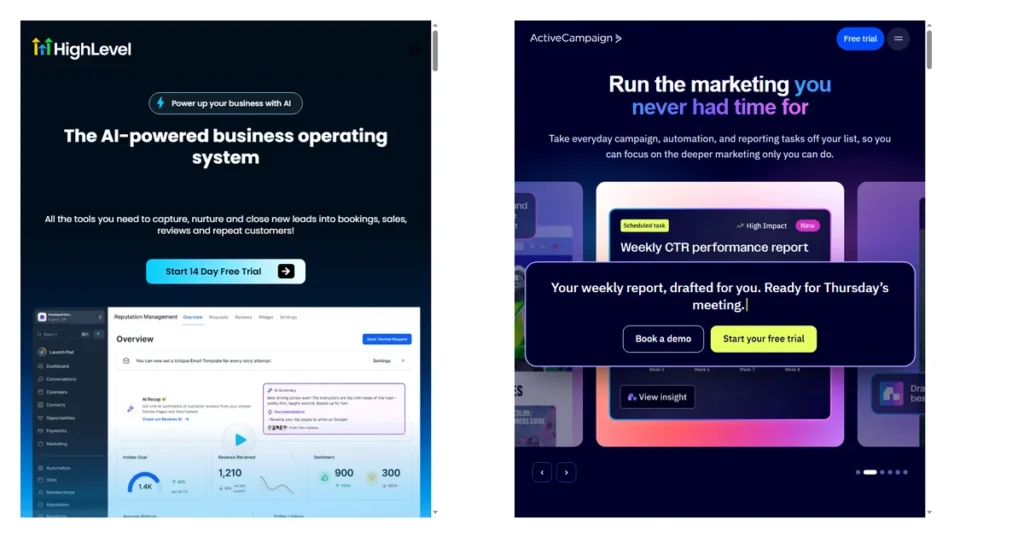
A 10,000-contact list on ActiveCampaign Plus runs $250+ per month, and that is before a funnel tool, a phone system, and a separate CRM join the bill. Add setup hours and the stack clears $500 monthly. The GoHighLevel vs ActiveCampaign question is really about paying for one broad system or several narrow ones. GoHighLevel charges a flat rate with unlimited contacts, so the arithmetic changes as your list grows.
- Best For: agencies and SMBs that want email plus funnels, CRM, and client delivery in one system (GoHighLevel); marketing teams that want a mature email automation and predictive sending engine (ActiveCampaign).
- Pricing: GoHighLevel $97/$297/$497 per month with unlimited contacts; ActiveCampaign $15/$49/$79/$145 per month (1,000 contacts tier, billed yearly).
- Strength (GHL): all-in-one CRM, phone, SMS, funnels, and sub-accounts around email.
- Strength (AC): advanced email segmentation, predictive sending, and deep automation for email specialists.
Below we compare both platforms across pricing, email marketing, automation depth, CRM and pipelines, agency use cases, integrations, and learning curve, then give a clear verdict for different buyer profiles. For a deeper side-by-side breakdown, see this GoHighLevel vs Keap comparison.
Table of Contents
- Agency Stack or Email Engine: The Quick Call
- Two Buyer Philosophies: Best-of-Breed Email vs One Agency System
- Email Specialist vs All-in-One Agency OS
- GoHighLevel vs ActiveCampaign Pricing Compared
- Email Marketing and Deliverability
- Automation and Workflows
- Build the Lead-to-Booking Flow in GoHighLevel
- Illustrative Scenarios: A Studio and a Marketing Team
- CRM and Pipelines
- Agency and Multi-Client Use
- Integrations and Ecosystem
- Onboarding Speed: Email Marketer vs Agency Operator
- Match the Platform to Your Daily Workflow
- Where GoHighLevel and ActiveCampaign Win
- FAQ
- Who Should Walk Away and Who Should Start
Agency Stack or Email Engine: The Quick Call
Agencies and businesses that need more than email get a stronger fit here, since CRM, funnels, phone, SMS, and white-label sub-accounts all sit around one automation engine. For a marketing team whose core discipline is email segmentation and predictive sending, ActiveCampaign remains a specialized, mature choice. In 2026, the deciding factor is scope: if email is one part of your operation, GoHighLevel wins; if email is your entire operation, ActiveCampaign is harder to beat.
Two Buyer Philosophies: Best-of-Breed Email vs One Agency System
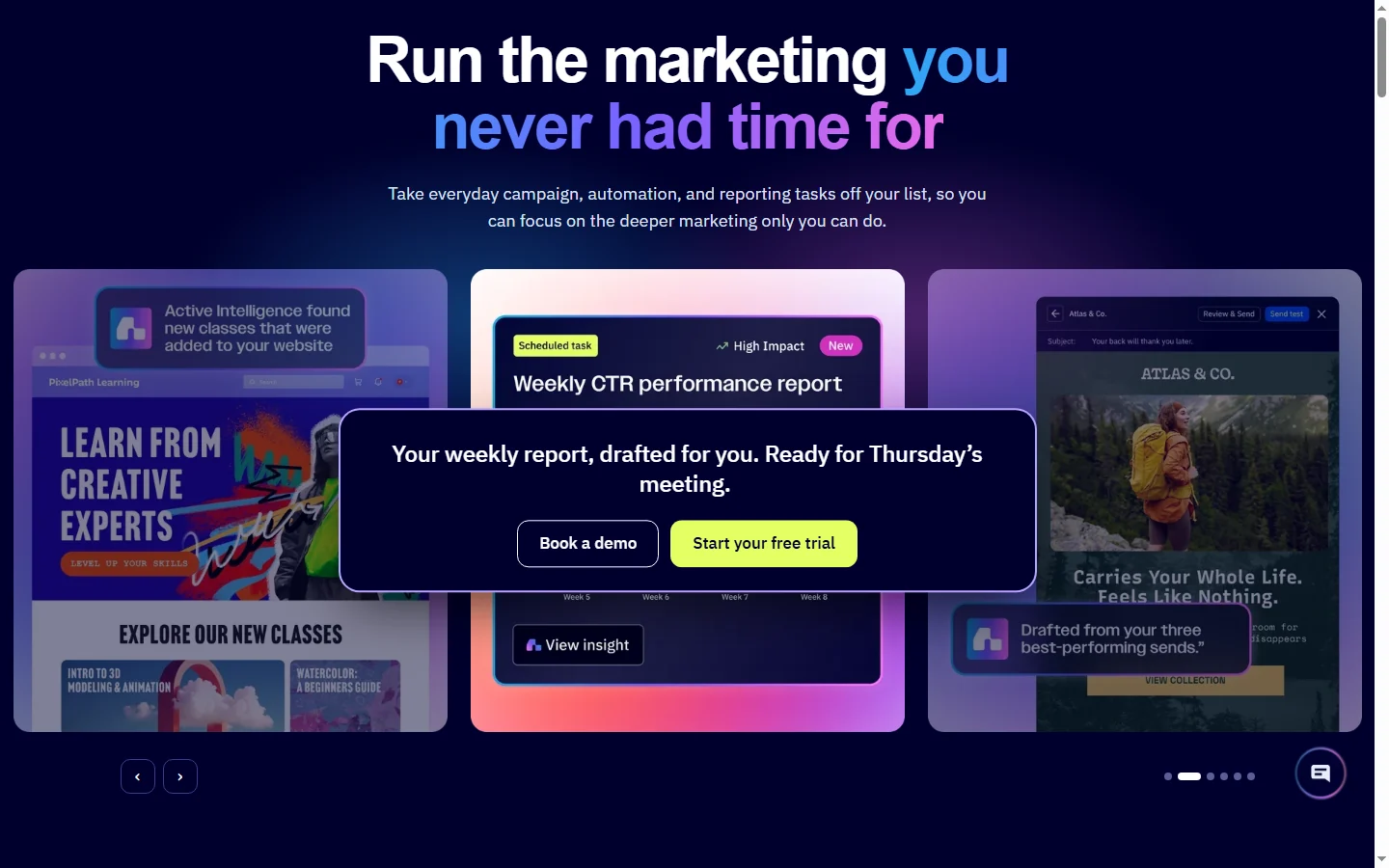
A buyer who picks ActiveCampaign usually starts with the inbox. They want predictive sending, conditional content, and segmentation that a dedicated email team can tune for years. Their budget logic is per contact: pay more as the list grows, but keep the sending engine specialized. The tool is owned by a marketing lead, not an operations lead.
A buyer who picks GoHighLevel starts with the client journey. They need funnels, phone, SMS, pipelines, and sub-accounts around the same contact record. Their budget logic is flat: one bill, unlimited contacts, and no per-client software sprawl. The tool is owned by an agency owner or ops manager who values speed over email nuance. Many of them compare options in our GoHighLevel vs HubSpot breakdown before deciding.
Each philosophy breaks down at the edges. The email-first buyer hits a wall when they add funnels, calling, and a second CRM, because integration maintenance eats the savings. The agency buyer hits a wall when they need advanced deliverability tooling or predictive send times at high volume, because GoHighLevel is not built as a dedicated email engine.
The honest split is scope. When email is the whole job, ActiveCampaign is the mature specialist. When email is one module in a client delivery machine, GoHighLevel removes the seams. Neither choice is wrong; they answer different questions about who owns the stack and what growth looks like next year.
Email Specialist vs All-in-One Agency OS
ActiveCampaign is a marketing automation and email marketing platform. It lets you build campaigns, segment contacts, score leads, and automate multi-step journeys. It includes a native CRM with pipelines and deal tracking, and it connects to ecommerce and helpdesk tools. The core identity remains email-first: you live in the campaign builder, automation editor, and contact database.
GoHighLevel is an all-in-one business operating system. Email marketing is one module among many. You also get a full CRM, funnel and website builder, SMS, call tracking, voice AI, reputation management, surveys, and agency sub-accounts. That breadth is the main difference: ActiveCampaign is a specialist tool, GoHighLevel is a generalist platform.
GoHighLevel vs ActiveCampaign Pricing Compared
| Plan | Monthly Price | Key Limits | Best For |
|---|---|---|---|
| GoHighLevel Starter | $97/month | 3 sub-accounts, core CRM, funnels, email, unlimited contacts | SMBs |
| GoHighLevel Unlimited | $297/month | Unlimited sub-accounts, full funnels + websites + phone | Agencies |
| GoHighLevel Agency Pro | $497/month | SaaS mode, whitelabel, advanced features | Reselling agencies |
| ActiveCampaign Starter | $15/month | 1,000 contacts, 15,000 email sends/month, basic automation | Solo founders |
| ActiveCampaign Plus | $49/month | 1,000 contacts, 12,000 sends, advanced automation + landing pages | Growing teams |
| ActiveCampaign Pro | $79/month | 1,000 contacts, predictive sending, conditional content | Marketing teams |
| ActiveCampaign Enterprise | $145/month | 1,000 contacts, custom reporting, dedicated support | Enterprise |
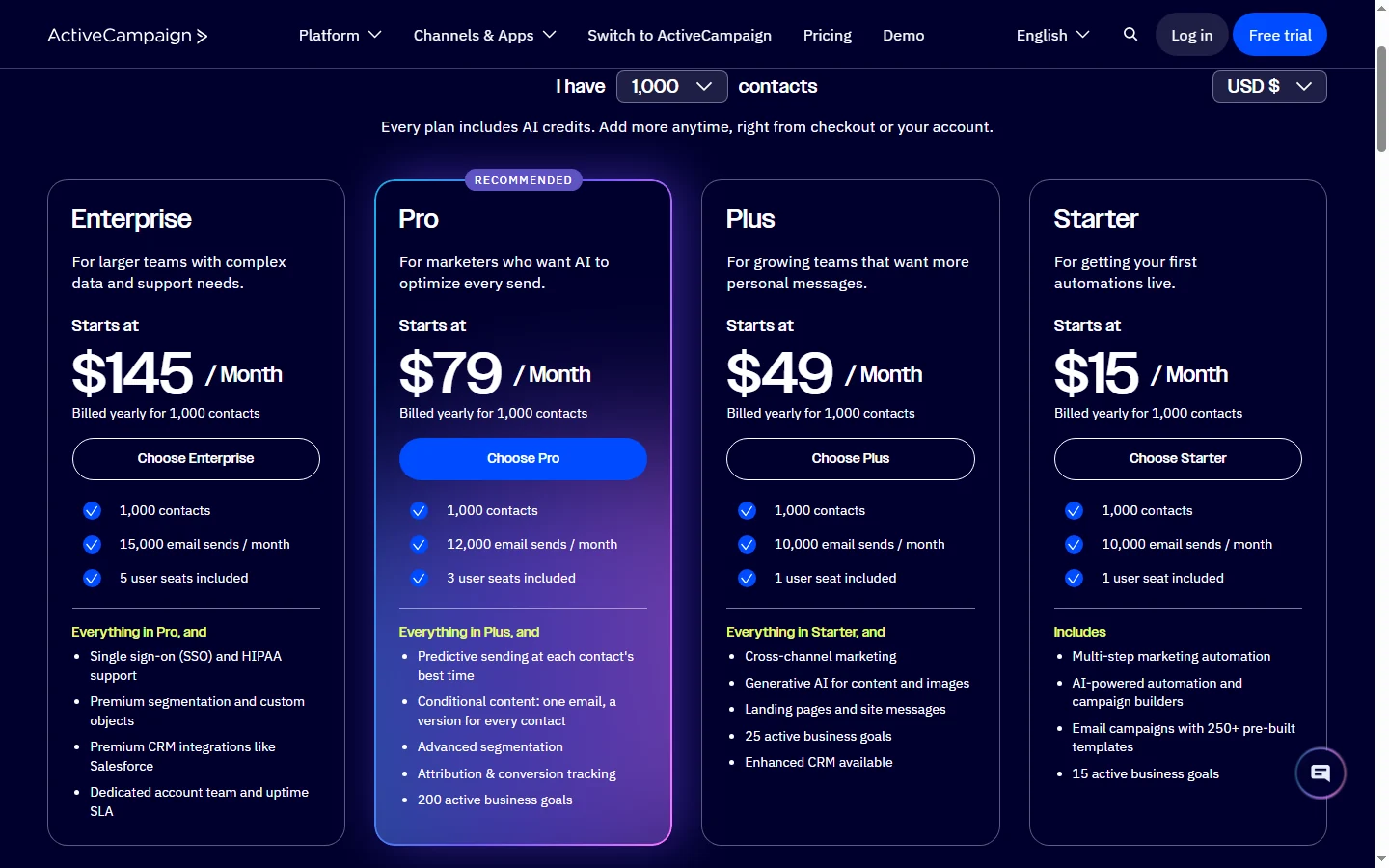
The pricing story is more nuanced than the headline number. ActiveCampaign scales by contact count: a 10,000-contact list on Plus jumps to $250+/month, and Enterprise goes much higher. GoHighLevel charges one flat rate with unlimited contacts on every plan, which changes the cost equation dramatically as your list grows. For an agency managing many clients, GoHighLevel almost always wins on cost per contact.
Email Marketing and Deliverability
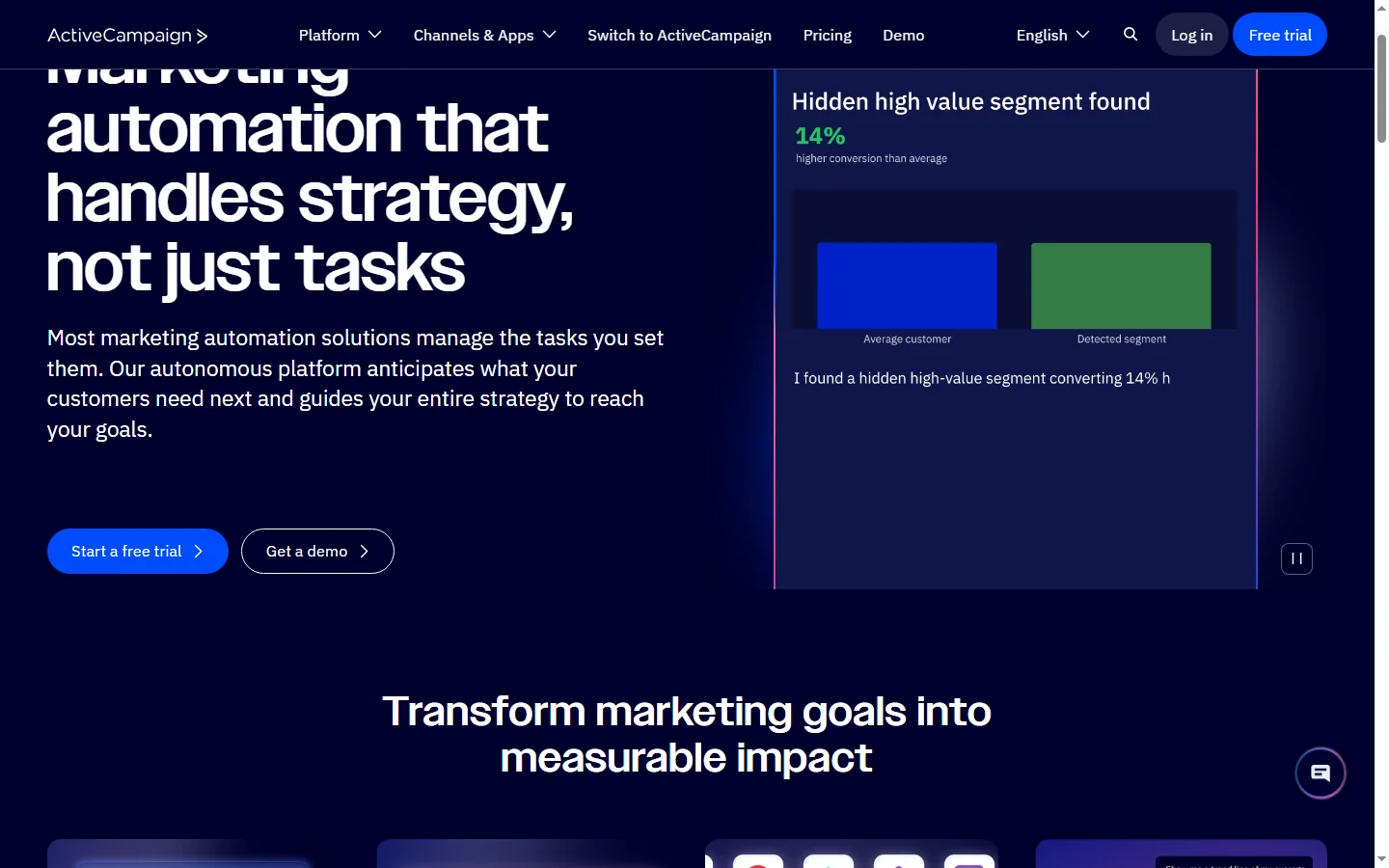
ActiveCampaign is a mature email platform. It gives you granular segmentation, custom fields, predictive sending that times emails at each contact’s best open hour, conditional content that shows a different version to each segment, and deep campaign reporting. Deliverability tooling is strong, with dedicated IP options for larger senders.
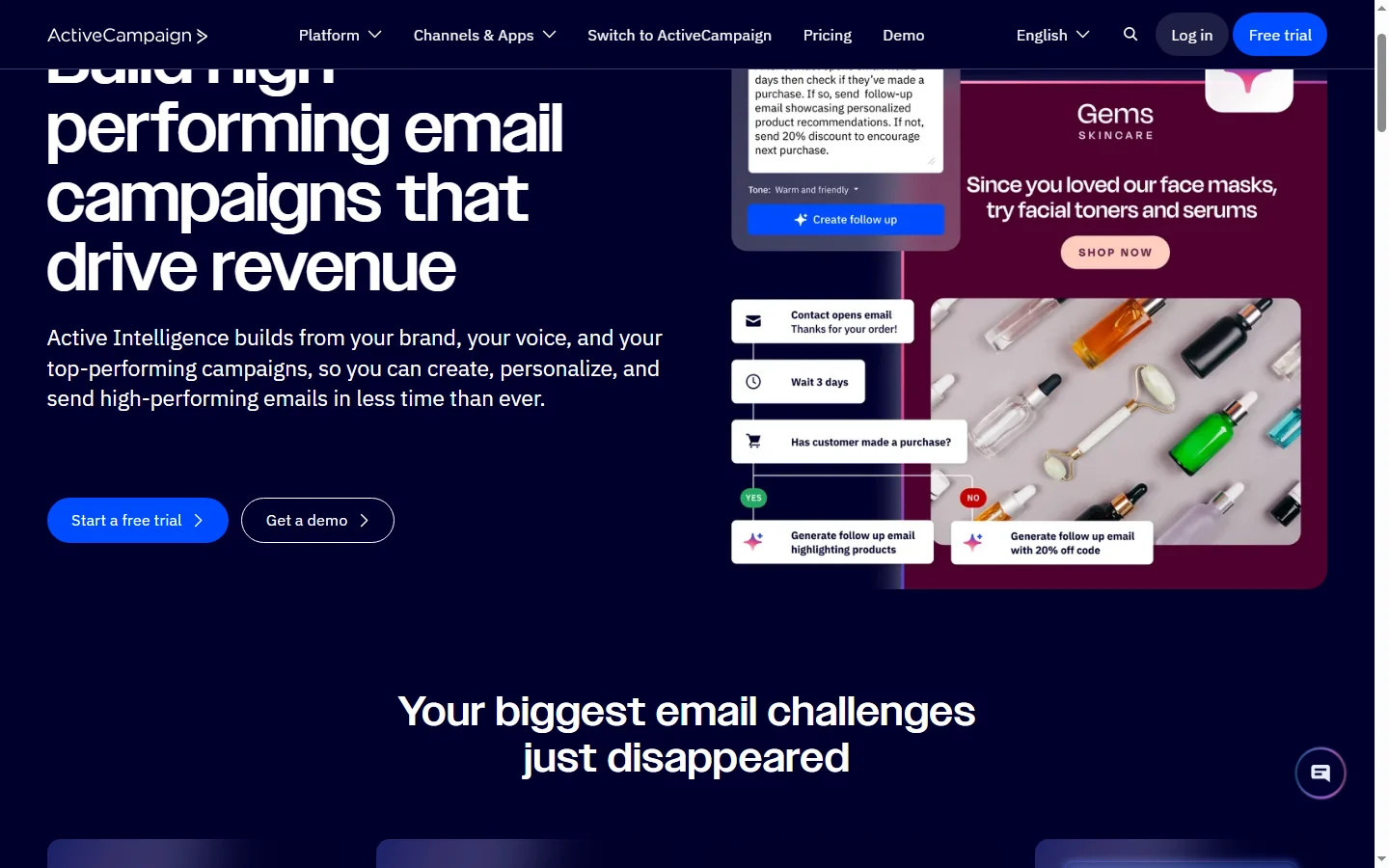
GoHighLevel provides email campaigns, sequences, broadcasts, and automation tied to contacts, but it is not built as a dedicated email deliverability engine. For high-volume, high-complexity email marketing with advanced predictive features, ActiveCampaign has the edge. For most agency and SMB use cases, GoHighLevel’s email is more than enough, and it sends from the same place you run your funnels and CRM.
Deliverability Reality Check
Both platforms require proper authentication, list hygiene, and warming for new domains. As of 2026, GoHighLevel has email sending limits and ramp-up for trial agencies, while ActiveCampaign gives you a dedicated sending infrastructure with higher daily caps on upper plans. If cold email volume or massive broadcast reach is your core need, test both with your real domain and inbox placement rates before committing.
Automation and Workflows
ActiveCampaign’s automation builder is deep: triggers, conditions, splits, goals, and multi-step journeys with a visual canvas. It is one of the most mature automation environments for email-first marketers. You can automate lead scoring, win-back, cart abandonment, and lifecycle programs with fine-grained control.
GoHighLevel workflows trigger on contact behavior across email, SMS, calls, forms, page visits, and payments, then run email, SMS, internal actions, and even AI voice. The automation is broader across channels, though not as deep for pure email logic. If you need the most sophisticated email journeys, ActiveCampaign wins; if you want one workflow that sends an email, a text, and logs a call at the same time, GoHighLevel wins.
Build the Lead-to-Booking Flow in GoHighLevel
This is the automation an agency or SMB builds to replace a stitched-together stack. It runs inside one sub-account and touches forms, SMS, email, pipelines, and tasks.
- Trigger: Form Submitted (the main website contact form). Action: Create/Update Opportunity in the pipeline stage ‘New Lead’. Action: Send SMS ‘Hi {{contact.first_name}}, thanks for reaching out. What day works best for a 15-minute call? Reply with a day.’
- Wait: 10 minutes. If/Else: contact replied. If yes, Action: Assign to User (the on-call setter) and Action: Internal Notification ‘New reply from {{contact.first_name}}’. If no, continue.
- Action: Send Email with subject ‘Quick question about your project’ and a one-line body asking for their goal. Wait: 1 day.
- If/Else: contact replied to the email. If yes, Action: Add Contact Tag ‘engaged’ and Action: Create/Update Opportunity stage ‘Contacted’. If no, Action: Send SMS ‘Just checking in, {{contact.first_name}}. Want me to send a few times that are open this week?’
- Wait: until 2 days after the form submission. If/Else: still no reply. Action: Voicemail Drop with a 20-second script, then Action: Add Task ‘Call lead manually’ assigned to the setter.
- Trigger: Customer Booked Appointment. Action: Send SMS ‘You are booked for {{appointment.start_time}}. Reply C to confirm or R to reschedule.’ Wait: until 24 hours before the appointment. If/Else: contact replied C. If yes, Action: Update Contact Field ‘confirmed’ = yes. If no, Action: Send SMS ‘Friendly reminder about tomorrow. Reply C to keep it or R to move it.’
- Trigger: Appointment Status (showed). Action: Add Contact Tag ‘attended’. Wait: 2 hours. Action: Send Review Request to the review link. If/Else: status was no-show. Action: Send SMS ‘Sorry we missed you. Want to grab another time this week?’ and Action: Add Task for the setter.
- Trigger: Payment Received. Action: Remove Contact Tag ‘new lead’, Action: Add Contact Tag ‘customer’, and Action: Internal Notification to the account owner with the amount.
Measure four numbers weekly: reply rate on the first SMS, form-to-booking conversion, appointment show rate, and task completion time for manual calls. If the first SMS reply rate sits under 10 percent, rewrite the wording before adding more steps. Our GoHighLevel pricing guide shows which plan covers this build.
Running the same flow in ActiveCampaign means building the email journeys there, then connecting separate tools for SMS, calling, booking, and pipeline tasks through integrations or webhooks. The email logic is deeper, but the cross-channel steps live outside the platform.
Illustrative Scenarios: A Studio and a Marketing Team
These are illustrative scenarios, not reports of real clients.
Imagine a fitness studio in Austin, Texas, with 400 members, two front-desk staff, and one part-time marketer. They run ActiveCampaign for email at 1,000 contacts and pay for a separate funnel tool, a phone app, and a booking system. The marketer spends about six hours a week copying leads between tools. If that admin time is worth $30 an hour, the hidden cost is $180 a week, or roughly $720 a month, on top of four subscriptions. Moving to GoHighLevel puts forms, pipelines, SMS reminders, and email in one sub-account. If the reminder flow saves 6 of 24 monthly no-shows at $120 a visit, that is $720 a month recovered, which covers the platform bill and the admin hours.
Imagine a B2B marketing team in Chicago with 12,000 contacts and a three-person email squad. They live in ActiveCampaign Pro for predictive sending and conditional content, and they already have a separate CRM and call platform. Their cost scales with contacts, but the email depth is the product. Forcing them onto GoHighLevel would trade away sending sophistication they use daily. Their philosophy is best-of-breed, and it holds as long as the surrounding stack stays lean.
CRM and Pipelines
ActiveCampaign has a native CRM with pipelines, deal stages, tasks, and deal contact relationships. It is solid for a marketing-led sales team and integrates with ecommerce. However, it is not the center of the platform; the contact record and automation are.
GoHighLevel is CRM-first. Pipelines, custom fields, opportunities, tasks, and per-contact activity history across every channel are core. For agency client work, the sub-account structure means each client gets its own CRM workspace. If your business runs on pipeline management with email as one touchpoint, GoHighLevel’s CRM depth is a significant advantage.
Agency and Multi-Client Use
This is GoHighLevel’s home turf. The sub-account model lets an agency spin up isolated workspaces per client, each with its own funnels, CRM, automations, and branding. On Agency Pro you get SaaS mode and white-label capabilities to resell the platform as your own product.
ActiveCampaign has partner and reseller programs, and agencies do manage client accounts, but it is not designed as a multi-tenant agency platform with per-client isolation and white-label SaaS. If you manage more than a few client accounts with separate branding, GoHighLevel’s structure saves real time and is a cleaner fit.
Integrations and Ecosystem
ActiveCampaign integrates with 900+ tools, including ecommerce platforms, helpdesks, CRMs, and webinar tools. It is a strong hub if you already run a best-of-breed stack for sales and support.
GoHighLevel has a native marketplace and API, plus native integrations for payments, calendars, phone, and social. It does not need as many integrations because much of the stack is built in. If you prefer one connected system, GoHighLevel reduces integration maintenance; if you want to keep your existing specialized tools, ActiveCampaign connects more broadly.
Onboarding Speed: Email Marketer vs Agency Operator
ActiveCampaign is approachable for email marketers. Campaign building and automation are intuitive, and there is extensive documentation and certification. The width of features still takes time to master, but the mental model stays email-centric.
GoHighLevel has more modules, so the initial learning curve is steeper. You learn the CRM, funnels, websites, phone, and workflow builder. However, HighLevel provides free training, a bootcamp, an academy, and a large agency community, and most operators find the platform clickable within a few days. The practical difference is scope: a new user can send an ActiveCampaign email faster, but a GoHighLevel user can run an entire client operation from one dashboard.
Match the Platform to Your Daily Workflow
- Choose GoHighLevel if you need email plus CRM, funnels, phone, SMS, and client delivery in one system, or you run an agency with multiple clients.
- Choose ActiveCampaign if your core discipline is email marketing automation and you already use separate tools for funnels, CRM, and phone.
- Choose by growth path: if you expect to add funnels, memberships, reviews, and pipeline management later, GoHighLevel scales further.
- Budget reality: compare total stack cost at your contact volume, because GoHighLevel’s unlimited contacts can beat ActiveCampaign at scale.
A practical way to decide: list the tools you currently use to run one campaign. If email is the only missing piece, ActiveCampaign fits. If you are stitching together a CRM, a funnel tool, an email tool, and a phone system, GoHighLevel consolidates them into one bill.
Where GoHighLevel and ActiveCampaign Win
- GoHighLevel: all-in-one CRM + funnels + email + SMS + phone + automation.
- GoHighLevel: unlimited contacts on paid plans.
- GoHighLevel: agency sub-accounts, white label, and SaaS mode.
- ActiveCampaign: mature email automation with predictive sending.
- ActiveCampaign: deep segmentation and conditional content.
- ActiveCampaign: dedicated email infrastructure for high volume.
Where Each Platform Falls Short
- GoHighLevel: steeper learning curve due to platform breadth.
- GoHighLevel: trial sending caps for new accounts.
- ActiveCampaign: pricing scales by contact count and grows fast.
- ActiveCampaign: weaker funnel builder and no SMS/call native features at the same depth.
- ActiveCampaign: not built as a multi-client agency platform.
FAQ
Is GoHighLevel better than ActiveCampaign? For agencies and businesses that need email plus CRM, funnels, phone, and SMS in one system, yes. For marketing teams that specialize in advanced email automation, ActiveCampaign remains a strong, focused choice.
Can GoHighLevel replace ActiveCampaign? For most agency and SMB email use cases, yes. GoHighLevel includes campaigns, sequences, broadcasts, and automation. Very high-volume or predictive-email-heavy operations may still prefer ActiveCampaign.
Which is cheaper, GoHighLevel or ActiveCampaign? At small contact counts ActiveCampaign appears cheaper, but it scales by contacts. GoHighLevel has a flat rate with unlimited contacts, so it often wins on cost per contact as your list grows. Compare your real stack.
Does GoHighLevel have email automation like ActiveCampaign? GoHighLevel also supports multi-step email sequences and broadcasts, with automations firing off what a contact does.
Which is better for an agency? GoHighLevel, because of sub-accounts, white label, SaaS mode, and the unified CRM. ActiveCampaign lacks the same multi-client operations model.
Can I use ActiveCampaign with GoHighLevel together? Yes, you can integrate them through webhooks or third-party connectors, but managing both duplicates contact data and cost. Most operators pick one.
Who Should Walk Away and Who Should Start
Walk away if your entire operation is high-volume email with predictive sending and you already own a lean CRM and call stack; ActiveCampaign is the specialist you want. Go ahead with GoHighLevel if you run an agency or SMB that stitches funnels, phone, SMS, and pipelines around email and wants one flat bill with unlimited contacts. Read why people quit GoHighLevel before you commit.
Disclaimer: We are an independent review site. Some links in this article are affiliate links, and we may earn a commission at no extra cost to you if you purchase through them. We only recommend tools we test in real client operations.
About the Author

Antonio Vance is B2B SaaS Operations Director & Lead Reviewer (SaaSFlowLab Editorial Team). He has spent 8+ years deploying and auditing enterprise CRM, marketing automation, and email deliverability infrastructures for digital agencies. At SaaSFlowLab, he directs hands-on testing of software stacks in live production environments to deliver uncompromised, field-verified software reviews.