
Executive Summary
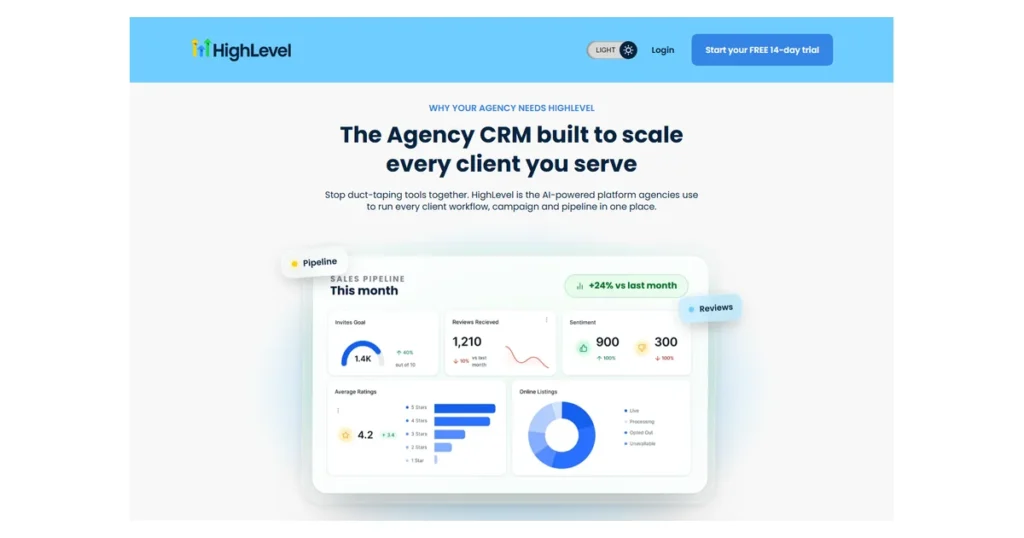
No, GoHighLevel does not need hosting. The platform runs on HighLevel’s own cloud, so your websites, funnels, landing pages, CRM, email marketing and automations are all served from that infrastructure. You do not buy a shared plan from Bluehost or SiteGround, install WordPress or manage a server. This guide is for solo marketers, local businesses and agencies who want one subscription to cover the marketing stack. It is not for teams whose main site must stay on WordPress, who run heavy custom applications, or who need dedicated video hosting or strict data residency. So does GoHighLevel need hosting? No—just a domain.
Before you go shopping for hosting, understand one thing: GoHighLevel is built to replace the entire stack – including the hosting layer. The money you would spend on a separate host, SSL, CDN and email server is already inside the subscription. This guide breaks down exactly what is included, what you still need, and when separate hosting is worth it.
Table of Contents
- What “Hosting” Actually Means
- Is Hosting Included in GoHighLevel?
- Websites & Funnels: Built and Hosted In-House
- Email Marketing: Infrastructure Included
- Custom Domain: The One Thing You Need
- Automate the Domain and Launch Check in GoHighLevel
- Two Agencies, Two Hosting Decisions
- GoHighLevel Pricing 2026: Hosting Is Bundled
- When You Still Need Separate Hosting
- GoHighLevel vs WordPress + Traditional Hosting
- Setup Guide: Hosting-Free Launch
- FAQ
- Hosting Decision: Keep the Subscription or Add a Host
What “Hosting” Actually Means
Hosting is just a computer that stores your website files and serves them to visitors. When someone types your URL, a hosting server sends them your HTML, images, and scripts. Traditional hosting products (shared hosting, VPS, dedicated servers, managed WordPress hosting) all do the same job with different levels of performance and control.
The question most people are really asking is: “Do I need to buy one of those hosting products to use GoHighLevel?” The answer is no, because GoHighLevel is a platform-as-a-service: the hosting is a feature of the product, not an add-on you have to assemble.
Is Hosting Included in GoHighLevel?
Yes. When you pay for any GoHighLevel plan, you are paying for the full stack. HighLevel’s own marketing states the platform includes a website, funnel and landing page builder, and those built-in properties run on HighLevel’s cloud, not on third-party hosts.
- Built-in website builder – drag-and-drop sites hosted on HighLevel’s infrastructure.
- Funnel builder – landing pages and sales funnels served instantly, no separate host.
- SSL & CDN – HTTPS and content delivery are handled by the platform; you do not configure certificates.
- Email sending – marketing email infrastructure is included in the subscription.
- CRM & client portals – the app itself runs in the cloud, accessible to you and your clients.
In short, hosting is bundled into the platform. The only “infrastructure” you bring is a domain name you control.
Websites & Funnels: Built and Hosted In-House
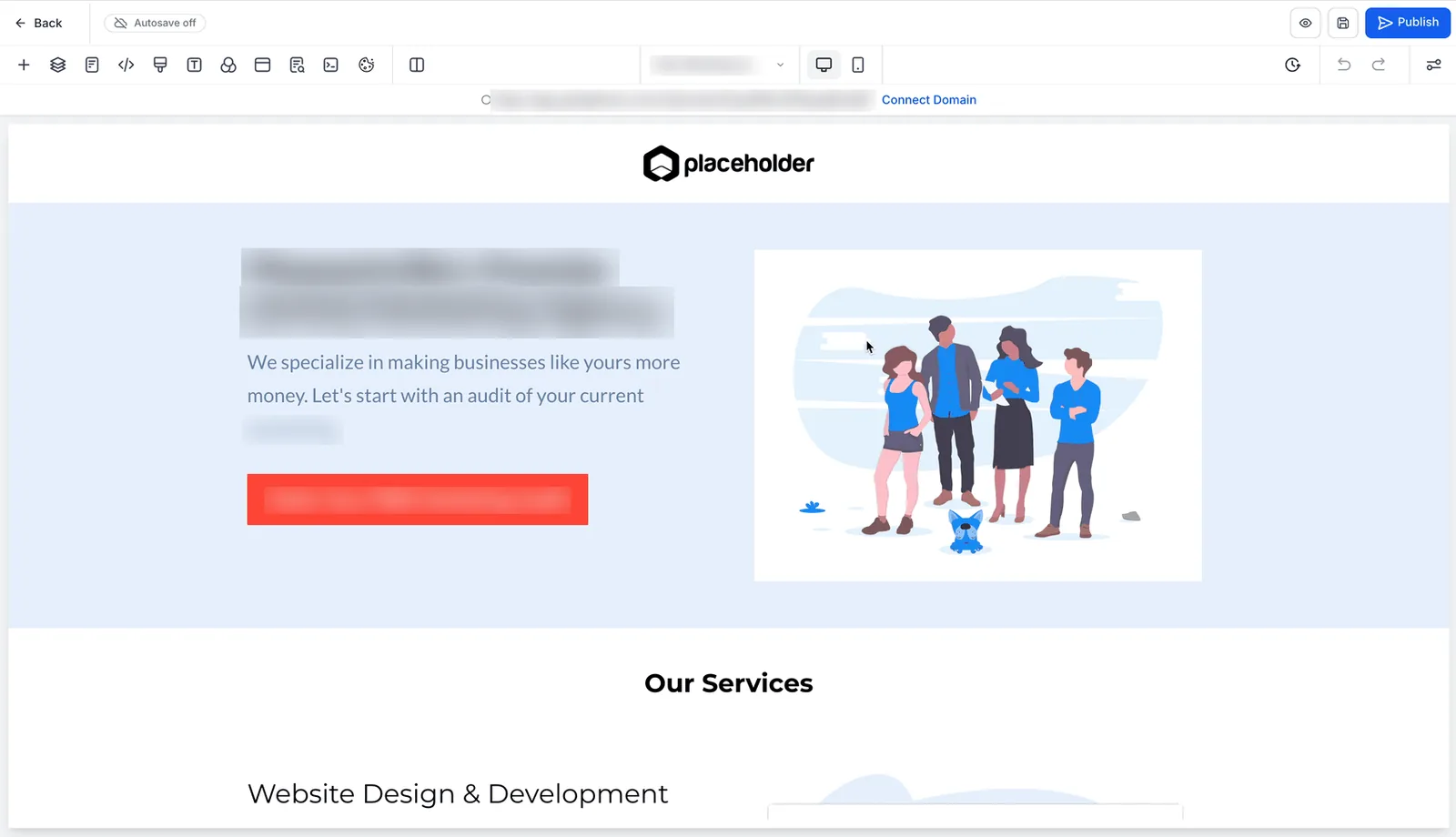
The GoHighLevel CRM page (verified in 2026) lists “Website, Funnel & Landing Page Builder” as a core feature of the platform. That means when you build a site or funnel in GoHighLevel, it is published on HighLevel’s own servers – no need to connect an external host, no FTP, no cPanel, no DNS A-record pointing at a hosting IP.
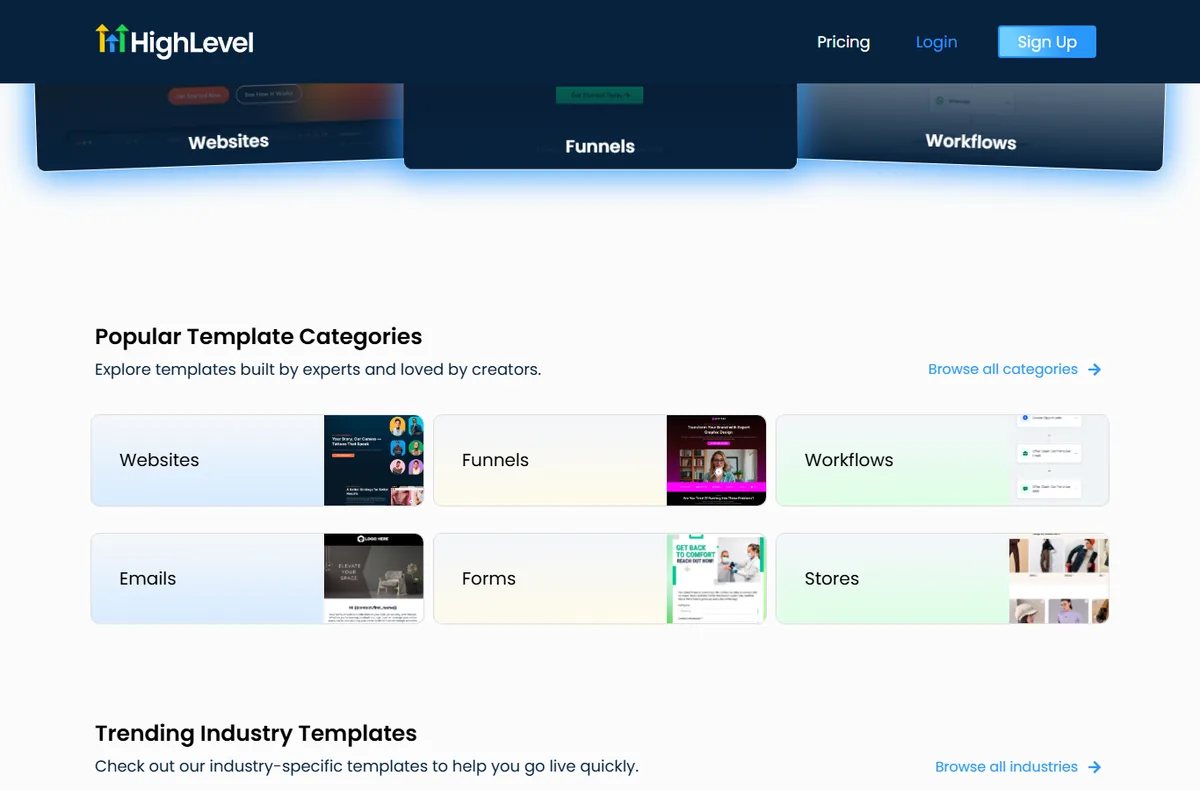
You pick a template from the HighLevel template library, customize it, connect your domain, and publish. Updates apply instantly across the platform. Because everything lives in one system, your pages, forms, automations and CRM share the same environment – which is the whole point of an all-in-one platform.
Email Marketing: Infrastructure Included
GoHighLevel includes email marketing and automation capabilities out of the box. The email marketing page describes drag-and-drop email builder, AI-powered design, smart segmentation, workflow automation, A/B testing and unified inbox – all part of the subscription.
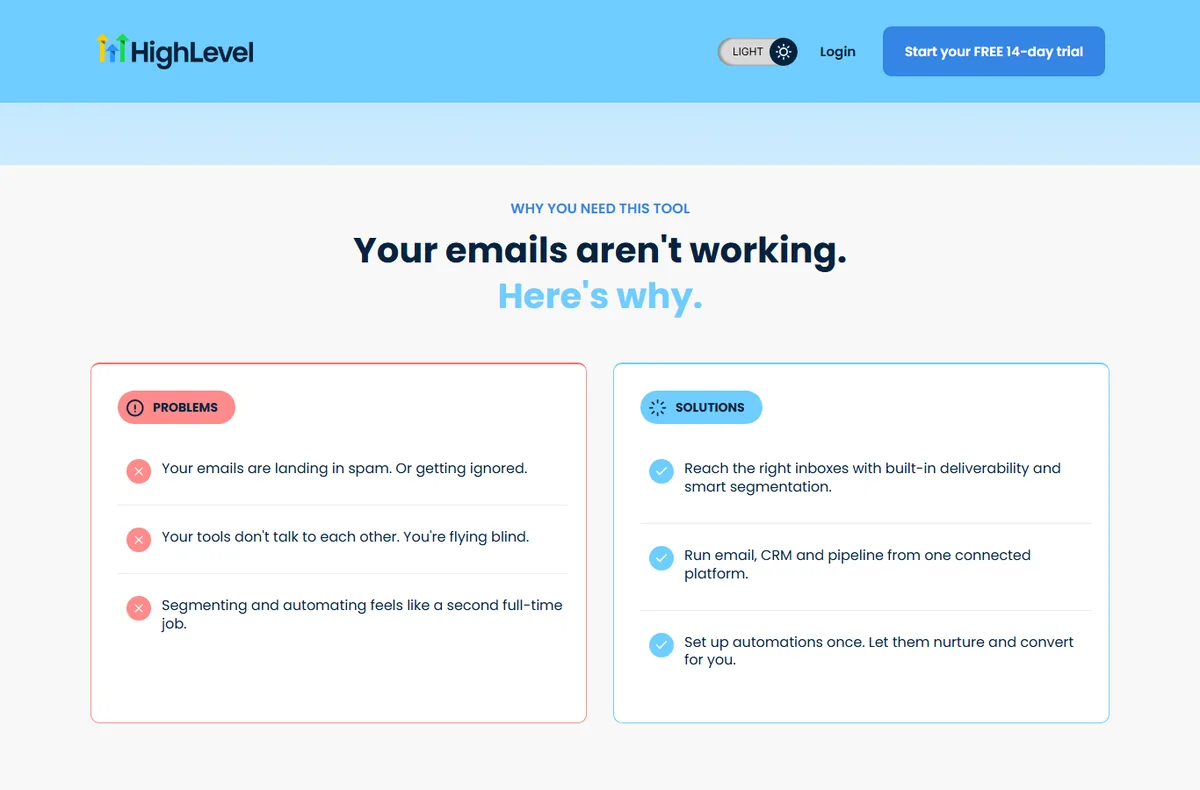
There is an important nuance: GHL’s email is marketing email (campaigns and automations), not business mailbox hosting. You still use Google Workspace or Microsoft 365 for your actual inbox (you@yourdomain.com). For sending, GHL handles deliverability setup with SPF, DKIM and DMARC, and each plan has sending limits. If you hit deliverability issues, our email fix guide walks through the 12 most common causes.
Custom Domain: The One Thing You Need
The only thing GoHighLevel does not bundle is your domain name. You need a domain you own (annual cost is roughly $10-$20), and you connect it to your GoHighLevel account via DNS settings. HighLevel gives you a free subdomain for testing, but for a professional site or client portal you will want a custom domain.
- Buy a domain – from Namecheap, Cloudflare, Google Domains, GoDaddy or any registrar.
- Verify ownership – add a TXT or CNAME record that HighLevel provides.
- Point DNS – set the A record or CNAME to HighLevel’s servers when you publish.
- White label – on Unlimited plans you can serve clients from your own branded domain.
This is a one-time 10-minute setup. After that, the domain points at HighLevel, and you are live.
Automate the Domain and Launch Check in GoHighLevel
Once a page is published, the risk is a broken form or a domain that never resolves. This workflow watches the first week after launch and tells you the moment a lead fails to arrive.
- Trigger: Form Submitted on the funnel’s ‘Free Audit Request’ form. Action: Add Contact Tag ‘launch-lead’. Action: Create/Update Opportunity in pipeline ‘New Client Sites’ at stage ‘Lead In’.
- Action: Send SMS to the lead: ‘Hi {{contact.first_name}}, your audit request landed. I am checking your site now and will send the first notes within one business day.’
- Wait: 1 hour. If/Else: check whether the contact has tag ‘domain-verified’. If yes, Action: Send Email with subject ‘Your site is live’ and body ‘The domain is pointing at our platform and HTTPS is active. Reply here if anything looks off.’ If no, Action: Internal Notification to the assigned user: ‘Domain not verified for {{contact.full_name}} – check DNS records.’
- Trigger: Customer Booked Appointment on calendar ‘Launch Review Call’. Action: Send SMS: ‘{{contact.first_name}}, you are booked for {{appointment.start_time}}. Bring your domain registrar login and we will finish the DNS step together.’
- Wait: until 24 hours before appointment time. Action: Send SMS reminder: ‘Quick reminder: launch review tomorrow at {{appointment.start_time}}. Reply YES to confirm.’
- Trigger: Appointment Status changes to No Show. Action: Add Task for the assigned user due in 2 hours: ‘Call {{contact.first_name}} and rebook the launch review.’ Action: Send SMS: ‘Missed you on the call. Reply with a time that works and I will hold the slot.’
- Trigger: Payment Received on invoice ‘Site Setup Fee’. Action: Remove Contact Tag ‘launch-lead’. Action: Send Review Request after a 3-day wait, with the message ‘The site has been live for a few days. If the launch went smoothly, a short review helps other owners decide.’
- Trigger: Custom Date Reminder set 7 days after publish date. Action: Send Email to the client: ‘One week in. Here is what the form captured and what the page loaded. Reply if you want changes.’ Action: Assign to User for a follow-up call.
Measure two numbers in the first week: the share of published pages whose domain resolves without a manual fix, and the count of form submissions that reach the CRM. If either drops below your target, the DNS step or the form connection is the first place to look.
Two Agencies, Two Hosting Decisions
Imagine a six-person marketing team in Austin, Texas, managing eleven local clients. Seven of those clients still pay a WordPress host about $25 a month each, plus a separate funnel tool at $79 a month for the whole agency. The owner wants every client site, form and follow-up in one login. She moves the seven client sites into GoHighLevel sub-accounts, connects each client’s existing domain through DNS, and cancels the seven hosting plans. That frees roughly $175 a month, and the funnel tool subscription goes away too. The trade-off is real: the agency’s own blog stays on WordPress because the team relies on plugins. This is an illustrative scenario, not a report of real outcomes.
Imagine a solo consultant in Portland, Oregon, running a $97 Starter plan with three sub-accounts. He builds a landing page for a dental client, publishes it on a HighLevel subdomain for a week of testing, then points the client’s domain at HighLevel. No SSL certificate to buy, no CDN to configure. His only outside purchase is the domain, about $15 a year. When a prospect asks who hosts the site, he says the platform does. The setup takes one afternoon, and the client never sees a server bill.
GoHighLevel Pricing 2026: Hosting Is Bundled
Verified directly from HighLevel’s pricing page in 2026:
| Plan | Price | What you get | Best for |
|---|---|---|---|
| Starter | $97/mo ($970/yr) | 3 sub-accounts, unlimited contacts & users, all core features | Solo marketers, small businesses |
| Unlimited | $297/mo ($2,970/yr) | Unlimited sub-accounts, full features, rebill phone/email, white label | Growing agencies and businesses |
| Agency Pro | $497/mo ($4,970/yr) | Unlimited + SaaS mode, white label, advanced features | Agencies building software products |
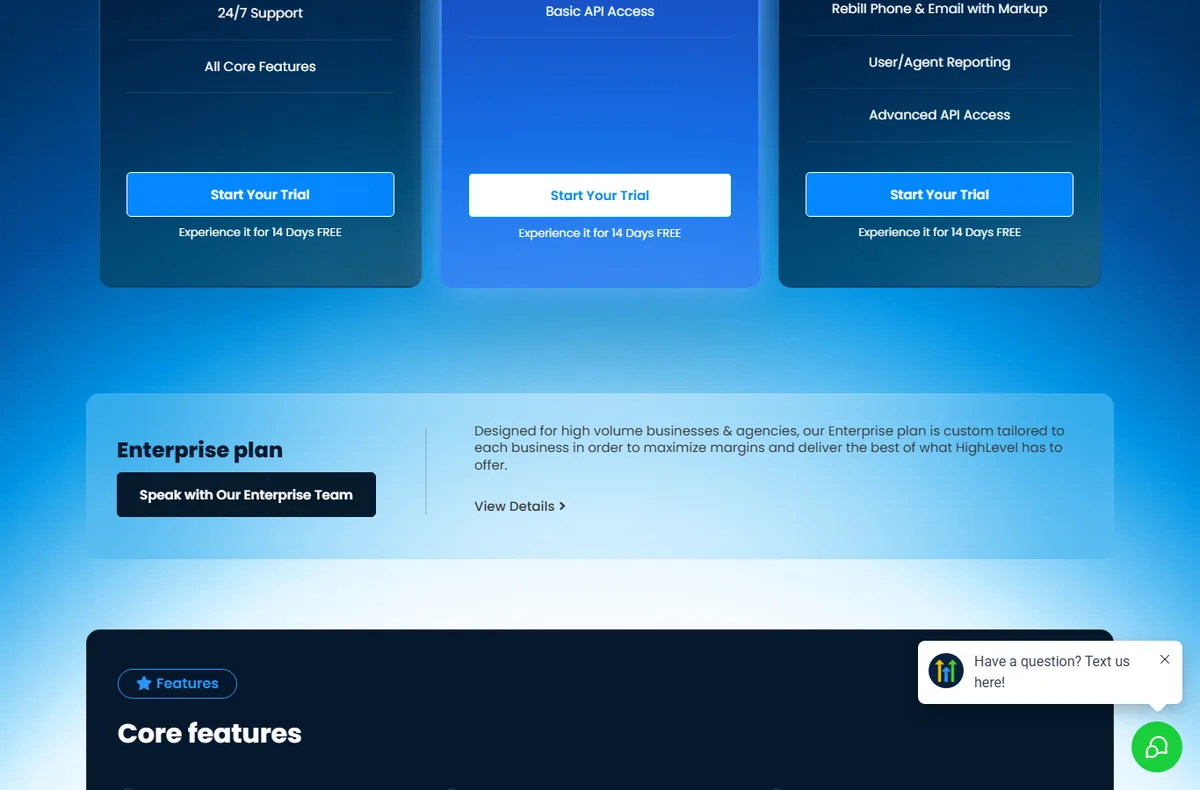
On every plan, hosting, SSL, CDN and the platform itself are included. There is no separate hosting fee line item. Compare that with the traditional stack: a WordPress host ($10-$30/mo), a funnel tool ($50-$150/mo) and an email tool ($30-$100/mo) – you can easily spend $150-$300/mo before you add the CRM. See our full pricing breakdown for the details.
When You Still Need Separate Hosting
There are legitimate cases where separate hosting still makes sense, even if GoHighLevel covers 95% of marketing needs:
- WordPress blog / main corporate site – if your primary site runs WordPress (like this review site does), keep it on a solid WordPress host.
- Heavy custom applications – a custom web app, membership platform with complex logic, or a custom API needs your own server or PaaS.
- Video hosting – large video libraries are better on YouTube/Vimeo/Wistia or object storage, not the page builder.
- Compliance and data residency – some industries require data to live in specific regions or on dedicated infrastructure.
- Email deliverability for big volumes – for very high-volume cold outreach, dedicated SMTP (e.g., SendGrid, Mailgun, Amazon SES) is an option alongside GHL.
If you need a WordPress companion site, our GoHighLevel vs WordPress comparison helps you decide the architecture. For most agencies and local businesses, though, the answer stays the same: you do not need separate hosting.
GoHighLevel vs WordPress + Traditional Hosting
| GoHighLevel | WordPress + hosting | Other SaaS stacks | |
|---|---|---|---|
| Hosting | Included (HighLevel cloud) | You manage: shared/VPS/managed WP host | Included (platform) |
| Setup time | Hours | Days to weeks | Hours |
| SSL / CDN | Automatic | Usually included but config varies | Automatic |
| Website + funnels | One builder | WordPress + plugins (and a funnel tool) | Depends on tool |
| Email marketing | Included (with limits) | Separate ESP/plugin | Included in email tools |
| CRM + automation | Built-in | Separate CRM + automation | Depends on stack |
| Monthly cost (typical) | $97-$497 | $15-$200 per tool, stack adds up | Varies |
| Best for | All-in-one marketing platform | Content sites, full control | Email/CRM specialists |
The honest take: WordPress + hosting wins when you need deep content control, plugins and complete freedom; GoHighLevel wins when you want one platform for marketing and client delivery with hosting taken care of. They are not always competitors – many teams run WordPress for their blog and GoHighLevel for funnels, CRM and client portals.
Setup Guide: Hosting-Free Launch
Here is the 30-minute path to a live GoHighLevel site with zero hosting purchases:
- Sign up for the 14-day free trial (no hosting, no credit card for the trial period on most plans).
- Pick a website or funnel template from the template library and customize copy, colors and images.
- Buy a domain at your registrar (about $10-$20/year) – the only outside purchase you need.
- Connect the domain in GoHighLevel: verify ownership and point DNS to HighLevel.
- Publish; HTTPS is automatic. Add a thank-you page and automation, then test a lead end-to-end.
- Optional: set up business email (Google Workspace/Outlook) separately for your mailbox, and connect SMTP if you scale sending.
That is the entire “infrastructure” task. There is no server to secure, no PHP version to update, no cache plugin to configure.
GoHighLevel Hosting FAQ
Does GoHighLevel need hosting? No. GoHighLevel is a cloud SaaS platform, so the hosting for its websites, funnels, landing pages and CRM is included in your subscription. You do not buy separate web hosting from HostGator, SiteGround, Bluehost or AWS to use GoHighLevel. You only need a domain name (and optionally a separate host if you keep a WordPress blog or app outside GoHighLevel).
Does GoHighLevel host websites? Yes. GoHighLevel includes a website builder, funnel builder and landing page builder that run on HighLevel’s own cloud infrastructure. The templates library lists website, funnel and landing page templates, and your sites are served from HighLevel, not from external hosting.
Does GoHighLevel require a custom domain? You need a domain name you own (or buy one) to publish a professional website or funnel with your own brand. GoHighLevel does not sell domains itself; you connect a custom domain to the platform. You can also use a free HighLevel subdomain while testing.
Does GoHighLevel include email hosting? Email marketing is included in GoHighLevel, but that is marketing email (campaigns, automations, follow-ups), not a full mailbox hosting service like Google Workspace. For business mailboxes (you@yourdomain.com), you still need an email provider. Authentication records for SPF, DKIM and DMARC are configured for you, and the volume you can send depends on your subscription tier.
When would I still need separate hosting with GoHighLevel? You need separate hosting when you run a WordPress blog, a resource-heavy application, video hosting, or a website that must be kept completely outside GoHighLevel (for example, your main corporate site on WordPress). For the majority of marketing sites, funnels and client portals, GoHighLevel hosting is enough.
Does GoHighLevel pricing include hosting costs? Yes. Hosting is bundled into the plan: Starter $97/month, Unlimited $297/month and Agency Pro $497/month (verified on HighLevel pricing pages in 2026). There is no separate line item for hosting, SSL or CDN on any plan, so your total cost is the subscription plus your domain name (roughly $10-$20/year).
Hosting Decision: Keep the Subscription or Add a Host
Track one number during the first month: how many pages you publish on a custom domain without opening a support ticket. If that count stays high and your forms feed the CRM, keep the subscription and skip the hosting purchase. If you keep paying a separate host for pages that already live in GoHighLevel, cancel that plan and put the savings into the next tier. The pricing breakdown shows what each tier adds, and the free trial guide covers the first two weeks. For teams weighing a move, the HubSpot comparison helps frame the decision.
Start on the 14-day free trial and publish your first page in the same session. If email deliverability is your concern, read our email fix guide, and if you are coming from WordPress, our comparison will help you plan the migration.
Disclaimer: We are an independent review site. Some links in this article are affiliate links, and we may earn a commission at no extra cost to you if you purchase through them. We only recommend tools we test in real client operations.
About the Author

Antonio Vance is B2B SaaS Operations Director & Lead Reviewer (SaaSFlowLab Editorial Team). He has spent 8+ years deploying and auditing enterprise CRM, marketing automation, and email deliverability infrastructures for digital agencies. At SaaSFlowLab, he directs hands-on testing of software stacks in live production environments to deliver uncompromised, field-verified software reviews.