Executive Summary
Picture a solo photographer in Austin sending ten proposals a month. Each one takes forty minutes to assemble, and two in five never get a reply. That is roughly seven hours of unpaid admin every month, plus the bookings that quietly slip away. HoneyBook at $29/month billed yearly puts branded proposals, contracts, and invoices in one template-driven flow. GoHighLevel at $97/month adds pipelines, landing pages, email, SMS, and workflow automation that keep leads warm before a proposal ever goes out. The GoHighLevel vs HoneyBook choice hinges on if you are purchasing a polished client experience or a full client-operations engine.
- Best For: photographers, planners, designers, and other service providers that want a beautiful client experience with proposals, contracts, invoicing, and scheduling (HoneyBook); agencies and growing businesses that want CRM, funnels, email, SMS, and automation inside one system (GoHighLevel).
- Pricing: HoneyBook Starter $29/month, Essentials $49/month, Premium $109/month (billed yearly, save up to 18%; verified October 2026); GoHighLevel $97/$297/$497 per month with unlimited contacts and seats.
- Strength (GHL): CRM, funnels, email, SMS, call tracking, and automation in one flat-rate platform with unlimited contacts and agency sub-accounts.
- Strength (HoneyBook): a polished, template-driven client experience: proposals, contracts, invoices, scheduling, and client portals designed to make service providers look premium.
Below we compare both platforms across pricing, CRM and contact management, client experience and proposals, contracts, invoicing and payments, scheduling, workflows and automation, client portals, integrations, agency use cases, and learning curve, then give a clear verdict for different buyer profiles.
Table of Contents
- HoneyBook or GoHighLevel: The Quick Pick
- Two Buying Philosophies: Client Polish vs Operational Reach
- Inside HoneyBook’s Client Suite and GoHighLevel’s CRM
- GoHighLevel vs HoneyBook Pricing Compared
- CRM and Contact Management
- Client Experience and Proposals
- Contracts and E-Signatures
- Invoicing and Payments
- Scheduling and Calendars
- Automation and Workflows
- Build the Proposal-to-Payment Follow-Up in GoHighLevel
- Two Scenarios: A Wedding Planner in Denver and a Marketing Agency in Tampa
- Client Portals and Forms
- Integration Ecosystem
- Agency and Multi-Client Use
- Onboarding Time: Templates vs Workflow Builder
- Match the Platform to Your Client Workflow
- Where HoneyBook Shines and Where GoHighLevel Wins
- FAQ
- The Right Pick for Creatives vs Agencies
HoneyBook or GoHighLevel: The Quick Pick
If you are a solo service provider or creative business that lives on branded proposals, contracts, invoicing, and client portals, HoneyBook is a beautiful, focused choice at a friendly price. If you run an agency or a growing business and want CRM, funnels, email, SMS, and automation in one system with unlimited contacts and sub-accounts, GoHighLevel is the stronger platform. In 2026, the deciding factor is whether you need a premium client-experience suite for service providers (HoneyBook) or a complete client-operations and marketing engine (GoHighLevel).


Two Buying Philosophies: Client Polish vs Operational Reach
A creative studio owner picks HoneyBook because the buying decision is about the client’s first impression. Proposals, contracts, and invoices arrive as one branded package, and the owner never has to think about funnels or pipelines. The budget logic is simple: $29 to $109 per month billed yearly buys a polished experience without hiring a designer or an ops manager. The tool is owned by the person doing the work, not by a marketing department.
An agency owner picks GoHighLevel because the buying decision is about how many client accounts one system can carry. Sub-accounts isolate each client’s CRM, funnels, calendars, and automations, and the flat $97 to $497 per month covers unlimited contacts and seats. The budget logic is replacement: one subscription stands in for a stack of separate tools, and the owner keeps the difference as margin.
Every philosophy fails at a distinct boundary. HoneyBook’s model struggles when a business needs multi-channel follow-up before a proposal, or when one owner wants to run marketing campaigns and track ad leads inside the same CRM. The template-driven flow is excellent at closing a warm lead and thin at generating one.
GoHighLevel’s model strains when the buyer only needs proposals, contracts, and invoices. The extra modules become unused surface area, and the steeper learning curve costs more time than the saved subscriptions are worth. A solo designer who sends five proposals a week does not need a funnel builder to look professional.
The honest split is this: buy HoneyBook when the client-facing document is the product, and buy GoHighLevel when the pipeline behind the document is the product. If you are still weighing a broader CRM, the GoHighLevel vs HubSpot comparison covers the enterprise side of that question.
Inside HoneyBook’s Client Suite and GoHighLevel’s CRM
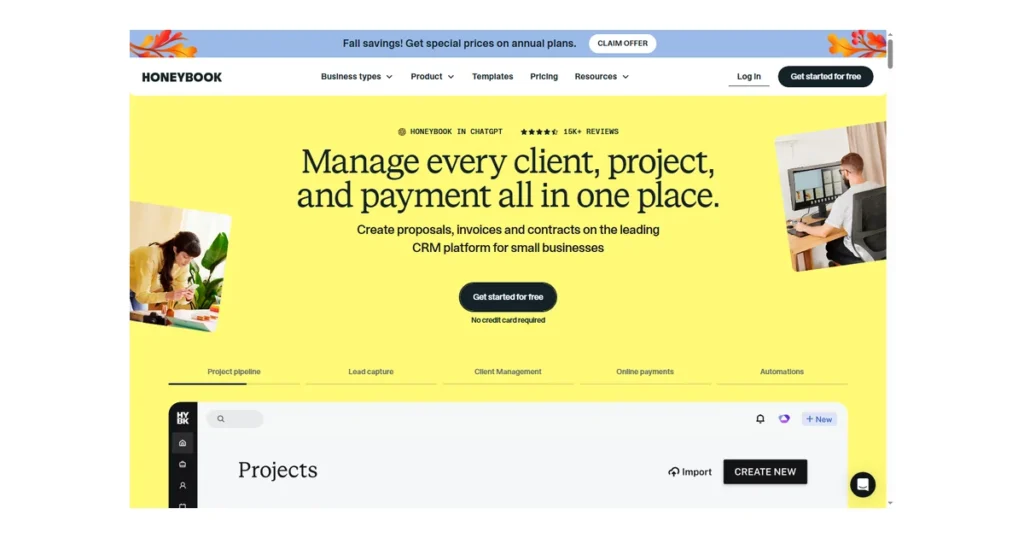
HoneyBook targets independent creative professionals who need proposals, contracts, invoices, scheduling, and client portals with a polished client experience. You capture leads, send proposals that clients can accept in one click, sign contracts, invoice and collect payments, schedule and send reminders, and manage the whole project in a client portal. It is template-driven and designed to make small businesses look polished. Plans start at $29/month billed yearly, and every plan includes unlimited clients and projects, invoicing and payments, proposals and contracts, calendars, and HoneyBook AI.
GoHighLevel is an all-in-one platform for agencies and SMBs. It includes a full CRM with pipelines and custom fields, funnels and websites, email marketing, SMS, call tracking, phone, voice AI, surveys, reputation management, and automation workflows. It is designed to run client operations end to end, with automation built around the same contacts and pipelines you already manage.

GoHighLevel vs HoneyBook Pricing Compared
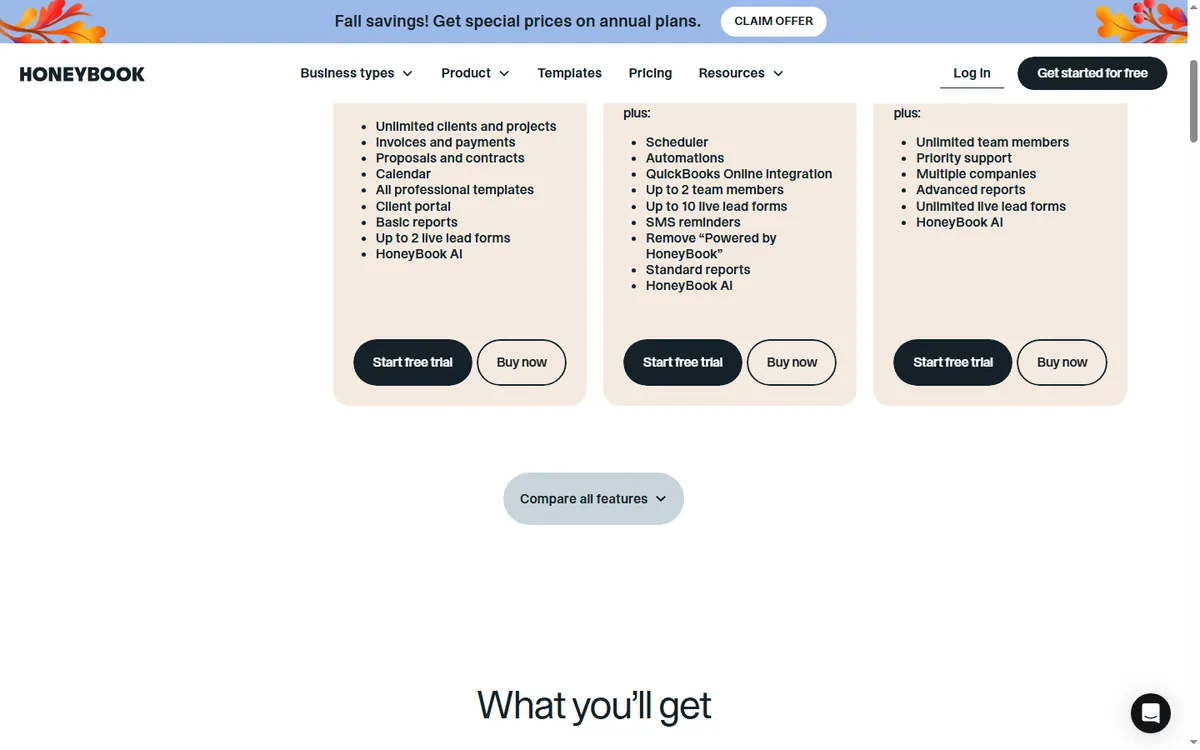
HoneyBook charges one flat rate per account: $29/month for Starter, $49/month for Essentials, and $109/month for Premium, all billed annually with savings up to 18%. Monthly billing is available at higher prices. Starter includes unlimited clients and projects, invoices and payments, proposals and contracts, calendar, all professional templates, client portal, basic reports, up to 2 live lead forms, and HoneyBook AI. Essentials adds scheduler, automations, QuickBooks Online integration, up to 2 team members, up to 10 live lead forms, SMS reminders, removing the Powered by HoneyBook branding, and standard reports. Premium adds unlimited team members, priority support, multiple companies, advanced reports, and unlimited live lead forms. Card processing fees start at 2.7% + 10 cents, with ACH at 1.5%.
GoHighLevel pricing is flat: Starter $97/month, Unlimited $297/month, and Agency Pro $497/month, with unlimited contacts and seats. For an agency running multiple clients, GoHighLevel replaces a stack of tools in one flat monthly price.
| Plan | Monthly Price | Key Limits | Best For |
|---|---|---|---|
| HoneyBook Starter | $29/month (yearly) | Unlimited clients and projects, invoices, proposals, contracts, calendar, client portal, HoneyBook AI | Solo providers |
| HoneyBook Essentials | $49/month (yearly) | Adds scheduler, automations, QuickBooks, 2 team members, SMS reminders, remove branding | Growing service businesses |
| HoneyBook Premium | $109/month (yearly) | The top tier also lifts team member limits, adds priority support, lets you manage multiple companies, and unlocks advanced reporting. | Established studios |
| GoHighLevel Starter | $97/month | 3 sub-accounts, core CRM, funnels, email, SMS, unlimited contacts | SMBs |
| GoHighLevel Unlimited | $297/month | Unlimited sub-accounts, full funnels + websites + phone | Agencies |
| GoHighLevel Agency Pro | $497/month | SaaS mode, whitelabel, advanced features | Reselling agencies |
The cost story is about scope. HoneyBook is cheaper for a solo provider who needs proposals, contracts, invoicing, and scheduling. GoHighLevel costs more at the starter tier but includes the CRM, funnels, email, SMS, and automation that HoneyBook does not. For a photographer who wants a premium client experience, HoneyBook is the focused, affordable choice. For an agency or a business that wants one platform for booking plus marketing and client delivery, GoHighLevel delivers more value per dollar.
CRM and Contact Management
HoneyBook is a client relationship platform: unlimited clients and projects, custom fields, a customizable project pipeline, pipeline automations, lead forms, tags, and a client portal. It is built around service projects rather than sales pipelines, and it excels at moving a lead through booking, proposal, contract, and invoice without creating a deal record.
GoHighLevel is CRM-first with pipelines, custom fields, opportunities, tasks, and per-contact activity history across email, SMS, calls, forms, and payments. It adds marketing and fulfillment layers that HoneyBook has in part: funnels, email campaigns, surveys, and reputation management. For agencies running many clients, GoHighLevel’s sub-account structure is a big operational advantage.
Client Experience and Proposals
HoneyBook is built around a premium client experience. You can create branded proposals that look like a mini sales page, and clients can accept in one click. Proposal templates, scheduling links, and branded forms make your business look professional without design work. The template library is a big reason service providers love HoneyBook.
GoHighLevel can create funnels, landing pages, and order forms with a drag-and-drop builder, and every form is wired to the CRM. The client-facing experience is more functional and conversion-focused than HoneyBook’s polished proposal flow. For premium proposal design out of the box, HoneyBook wins; for funnel-driven lead capture and follow-up, GoHighLevel is stronger.
Contracts and E-Signatures
HoneyBook includes legally binding contracts with e-signatures built in. You can send a contract as part of the same proposal-and-invoice flow, and clients sign in minutes. Templates keep your paperwork consistent. It is a core, well-executed feature for service businesses.
GoHighLevel does not have a native e-signature contract engine like HoneyBook. You can collect digital signatures through form fields or integrate with e-signature tools, but contracts are not the centerpiece of the platform. If your business lives on signed contracts, HoneyBook is the stronger native fit.
Invoicing and Payments
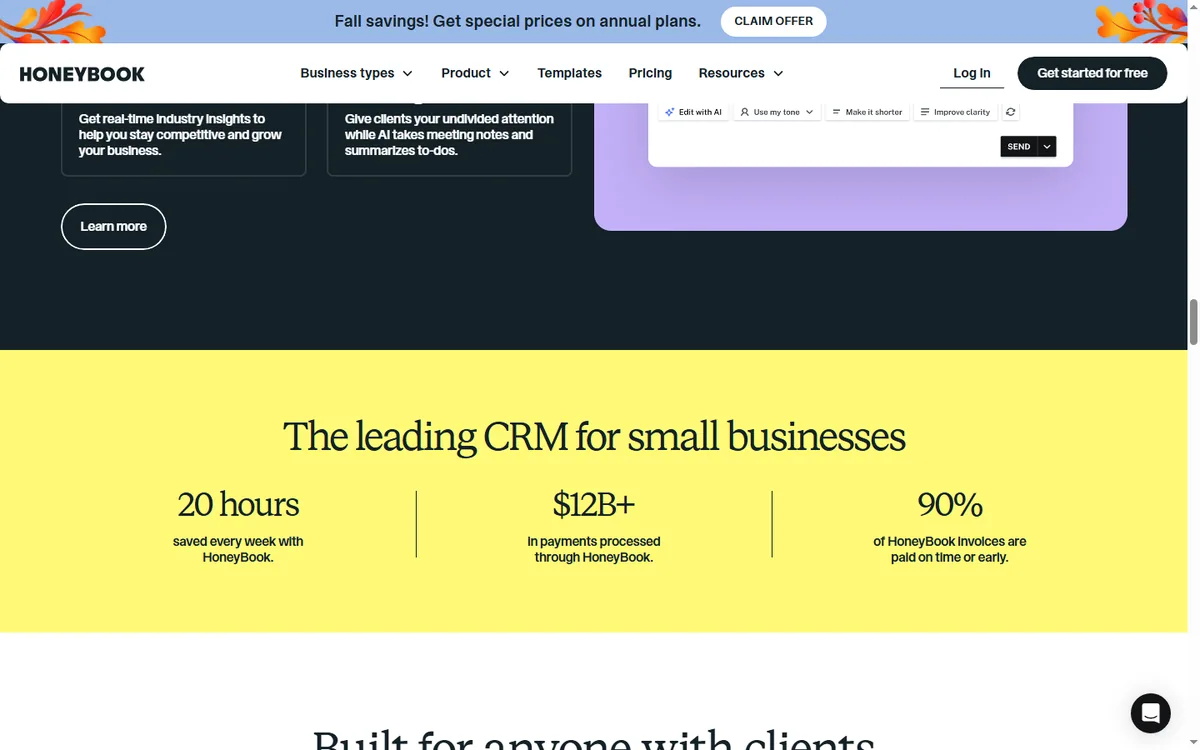
HoneyBook has invoicing and payment plans, payment reminders, late fees, autopay, and instant deposits. It supports card payments at 2.7% + 10 cents and ACH at 1.5%, and clients can pay from their digital wallet. It is a complete, polished billing experience for service businesses.
GoHighLevel can collect payments through Stripe on invoices, memberships, and funnel order forms, and it supports one-time offers and subscription billing. Payments connect to the CRM and automation, so a payment can trigger pipeline moves, email receipts, and delivery workflows.
Scheduling and Calendars
HoneyBook Essentials and above include a scheduler: clients book calls or appointments through your branded scheduling link, with automatic meeting reminders by email and SMS. It is clean and simple, designed for service providers who book discovery calls and sessions.
GoHighLevel calendar covers appointment types, availability, buffer times, payments, reminders, and booking links, and every booking creates or updates a contact in the CRM with the full activity history. It is integrated with the whole operations stack, which is more powerful for agencies and multi-step booking funnels.
Automation and Workflows
HoneyBook Essentials and above include pipeline automations and project automations: triggers that move projects along your pipeline, send emails, set tasks, and keep your process running. For a service business, it is practical and easy to set up without technical skills.
GoHighLevel workflows are contact-centric and multi-channel. They trigger on contact behavior across email, SMS, calls, forms, page visits, and payments, then run email, SMS, internal actions, and even AI voice. For businesses that want automation around the entire client lifecycle, GoHighLevel is more capable.
Build the Proposal-to-Payment Follow-Up in GoHighLevel
This is the automation a service business builds when a lead requests a quote through a GoHighLevel form and then books a call. It runs on the contact record, so every message and status change stays in one timeline.
- Trigger: Form Submitted on the form named ‘Project Quote Request’. Action: Add Contact Tag ‘quote-request’. Action: Create/Update Opportunity in the pipeline ‘Client Projects’ at stage ‘New Inquiry’. Action: Assign to User, round-robin across the three planners.
- Action: Send SMS within one minute: ‘Hi {{contact.first_name}}, this is Dana at the studio. I have your quote request and will send a proposal link today. What date are you hoping to book?’
- Wait: 2 hours. If/Else: check whether the contact has the tag ‘replied’. If yes, go to the booking branch. If no, Action: Send Email with subject ‘Your {{contact.first_name}} project quote’ and a link to the calendar ‘Discovery Call’.
- Trigger: Customer Booked Appointment on the calendar ‘Discovery Call’. Action: Send SMS: ‘You are booked for {{appointment.start_time}} with Dana. Reply here if you need to move it.’ Action: Add Task for the assigned planner due one day before the appointment.
- Wait: until 24 hours before the appointment time. Action: Send SMS reminder: ‘Quick reminder about tomorrow at {{appointment.start_time}}. Bring your venue ideas and I will bring the timeline.’
- Trigger: Appointment Status changes to ‘Showed’. Action: Update Contact Field ‘stage’ to ‘Proposal Sent’. Action: Send Email with the proposal and contract link. Wait: 3 days.
- If/Else: check whether the opportunity stage is ‘Signed’. If yes, Action: Send SMS: ‘Contract received, {{contact.first_name}}. Invoice is in your portal and the deposit link is live.’ If no, Action: Send SMS: ‘Checking in on the proposal. Any questions on the scope or the dates?’ and Wait 2 days, then repeat once.
- Trigger: Payment Received on the deposit invoice. Action: Add Contact Tag ‘deposit-paid’. Action: Send Review Request after 7 days. Action: Internal Notification to the assigned planner: ‘Deposit cleared for {{contact.full_name}}.’
Track two figures in month one: the share of quote requests that book a call, and the share of booked calls that reach a signed contract. A rising booking rate with a flat signing rate points to the proposal step, not the follow-up. HoneyBook can run pipeline and project automations on Essentials and above, but the same flow would need its scheduler, SMS reminders, and proposal templates wired together inside HoneyBook’s project structure rather than a contact-centric workflow canvas.
Two Scenarios: A Wedding Planner in Denver and a Marketing Agency in Tampa
Imagine a wedding planning studio in Denver with three planners and about forty events a year. Proposals go out as PDFs, contracts are signed through a free e-sign tool, and invoices are built in a spreadsheet. The owner spends roughly six hours a week on paperwork and chases deposits by text. Two deposits a quarter arrive late enough to strain cash flow. This is a sample scenario, not a record of a real engagement.
Moving to HoneyBook at $49/month billed yearly puts proposals, contracts, and invoices in one template flow. The planner builds a proposal once, attaches the contract, and the client accepts and signs in one session. Payment reminders run on autopilot, and the client portal holds the event timeline. If the studio recovers even one late deposit per quarter and saves four admin hours a week, the $588 annual cost is covered many times over by the recovered cash alone.
Imagine a marketing agency in Tampa with eight staff and twenty-two retainer clients. Every client needs a booking calendar, a lead form, and follow-up texts, and the agency now pays for a form tool, an email platform, and a scheduling app across all accounts. The monthly stack runs well past $400 and the owner reconciles logins every week. Also illustrative.
GoHighLevel at $297/month replaces those subscriptions with one login and twenty-two sub-accounts. Each client gets its own CRM, calendar, and workflow, and the agency bills the automation as part of its retainer. The math is straightforward: one flat fee against a stack of separate bills, plus the hours saved on account admin. For a team comparing email-first platforms, the GoHighLevel vs ActiveCampaign breakdown shows where the campaign tools overlap.
Client Portals and Forms
HoneyBook gives every client a dedicated, on-brand portal for project access, documents, forms, and communication. It is a polished touch that makes clients feel organized and cared for. Forms and questionnaires are template-driven and easy to reuse.
GoHighLevel has custom forms, surveys, and funnel form builders, and you can collect intake data at booking. It does not emphasize a client portal the way HoneyBook does, but it stores full activity history and communications in the CRM.
Integration Ecosystem
HoneyBook integrates with QuickBooks Online on Essentials and above, plus payment gateways, calendars, and a growing list of partners. For a service business, the practical integrations cover what you need: accounting, payments, and scheduling.
GoHighLevel has a native marketplace, API, webhooks, and works with Zapier and Make itself. Its native integrations cover what agencies and SMBs typically need, and you can still connect it to the wider ecosystem. For marketing and client-operations integrations, GoHighLevel is broader.
Agency and Multi-Client Use
HoneyBook serves individual businesses and small teams well. Premium adds unlimited team members and multiple companies, but it is not an agency white-label platform with sub-accounts dedicated to client operations and SaaS reselling. It is designed for the business owner who runs their own client work.
GoHighLevel is built for agencies. Sub-accounts give each client an isolated workspace with its own CRM, funnels, sites, calendars, and automations. On Agency Pro you get SaaS mode and white-label capabilities to resell the platform. Managing dozens of client accounts inside one system is the core design.
Onboarding Time: Templates vs Workflow Builder
HoneyBook is approachable for service providers, with templates doing most of the heavy lifting. The onboarding is straightforward, and the support team and resources are well regarded. You can be sending branded proposals within a day.
GoHighLevel has more modules, so the initial learning curve is steeper. You learn the CRM, funnels, websites, and workflows alongside each other. However, HighLevel provides free training, an academy, and a large agency community, and most operators find the platform clickable within a few days.
Match the Platform to Your Client Workflow
- HoneyBook suits solo creatives who prioritize a beautiful client-facing experience over marketing firepower.
- GoHighLevel suits agencies and SMBs that need a full marketing and client-operations engine with unlimited contacts and sub-accounts.
- Choose by stack: HoneyBook is a client-experience suite; GoHighLevel is an operations and marketing engine behind the client experience.
- Choose by price: for a solo provider, HoneyBook at $29/month is cheaper; for an agency scaling clients, GoHighLevel replaces multiple subscriptions.
A practical way to decide: map your operation. If your business is built on proposals, contracts, and project workflows with clients, HoneyBook is a beautiful, focused answer. Agencies needing sub-accounts and unlimited contacts get more value from GoHighLevel’s flat pricing.
Where HoneyBook Shines and Where GoHighLevel Wins
- It bundles contacts, pipelines, websites, and messaging into a single subscription.
- GoHighLevel: flat pricing with unlimited contacts and seats.
- GoHighLevel: agency sub-accounts, white label, and SaaS mode.
- GoHighLevel: multi-channel automation around the client lifecycle.
- HoneyBook: beautiful branded proposals and client experience.
- HoneyBook: contracts, invoicing, scheduling, and portals in one friendly package.
HoneyBook Gaps and GoHighLevel Tradeoffs
- GoHighLevel: broader platform means a steeper initial learning curve.
- GoHighLevel: no native e-signature contract engine like HoneyBook.
- HoneyBook: not a full marketing platform with funnels, email campaigns, and SMS broadcast at the same depth.
- HoneyBook: automations and scheduling require Essentials or above.
- HoneyBook: not built for multi-client agency operations.
FAQ
Is GoHighLevel better than HoneyBook? Agencies and growing businesses that want everything in one place tend to pick GoHighLevel. For solo service providers that want polished proposals, contracts, and client management, HoneyBook is the stronger, more affordable choice.
Can GoHighLevel replace HoneyBook? For many common use cases, yes. GoHighLevel has funnels, forms, scheduling, invoices, and automation wired into its CRM. If your business depends on HoneyBook’s branded proposals and e-signature contracts, you may keep both or migrate carefully.
Which is cheaper, GoHighLevel or HoneyBook? HoneyBook starts at $29/month, so it is cheaper as a client-experience suite. GoHighLevel starts at $97/month flat with unlimited contacts, seats, and sub-accounts, plus CRM, funnels, email, and SMS. Which is cheaper depends on what you need it to do.
Does GoHighLevel integrate with HoneyBook? You can connect them through webhooks and integration tools like Zapier and Make, so you can sync clients and projects between the two platforms.
Which is better for an agency? GoHighLevel, because of sub-accounts, white label, SaaS mode, and the unified CRM. HoneyBook is excellent for individual service providers, but it is not a client-operations platform.
Can I use GoHighLevel and HoneyBook together? Yes, they can complement each other: HoneyBook runs the branded client experience and contracts, and GoHighLevel runs the marketing, funnel, email, and SMS operations behind them.
The Right Pick for Creatives vs Agencies
Monitor one metric in the first 30 days: the percentage of quote requests that turn into a booked call. If that number climbs and your admin hours drop, keep the platform. If bookings stay flat and you are still assembling proposals by hand, cancel before the next billing cycle. For a wider look at funnel-first tools, read the GoHighLevel vs ClickFunnels review.
Disclaimer: We are an independent review site. Some links in this article are affiliate links, and we may earn a commission at no extra cost to you if you purchase through them. We only recommend tools we test in real client operations.
About the Author

Antonio Vance is B2B SaaS Operations Director & Lead Reviewer (SaaSFlowLab Editorial Team). He has spent 8+ years deploying and auditing enterprise CRM, marketing automation, and email deliverability infrastructures for digital agencies. At SaaSFlowLab, he builds each review from the vendors’ published pricing pages, help-center documentation and changelogs, cross-checks them against verified user reviews, and re-checks prices and plan limits every month.